The SEO life cycle is the four-phase SEO process we have run at Macronimous since 2002: Foundation (goals, market, keywords), Optimization (technical and content work on the site), Promotion (indexing and links), and Measurement (reporting and refinement). AI now sits inside every phase as a fast first pass, but the decisions in each phase still belong to a person who is accountable for the result.
On this page
The cycle did not change. What feeds it did.
This page has described the same four phases of SEO since the early 2000s, and we have rewritten it several times as search engines changed. This latest rewrite is the first one where the phases themselves stayed put and almost everything inside them moved.
Two things moved, and we wrote up the strategic side of both in our current SEO strategy write-up. First, the answer now often comes from an AI engine: Google’s AI Overviews and AI Mode, ChatGPT, Perplexity, Claude. A page can rank on page one and still get read by a machine that summarizes it and sends the visitor somewhere else. Second, the SEO work itself can be partly done by AI, and the popular advice says to let it. The usual line is that AI does the heavy lifting and a human polishes at the end.
We think that advice has it backwards. The heavy lifting in SEO was never the typing. It was deciding which keywords are worth money, which pages deserve a rewrite and which should be left alone, which links are worth asking for, and what a traffic dip actually means. Those are the expensive parts, and they are exactly the parts a pipeline skips when it treats the human as a proofreader. So this page does two jobs. It still lays out the SEO workflow we follow. It also says, phase by phase, what we give to AI, what we keep, and what it costs either way.
One more thing before the phases. Google’s own documentation on AI features in Search says there are no extra files, no special markup, and no new requirements to appear in AI Overviews or AI Mode. The same fundamentals apply. That matches what we see, and it is why the cycle below still looks familiar.
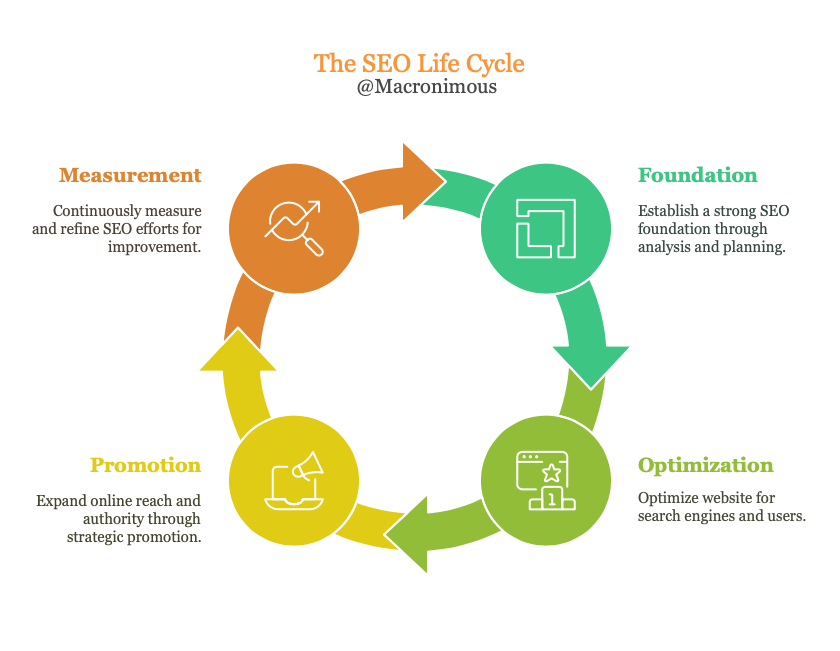
Phase 1: Foundation
Everything downstream depends on this phase being honest. If the goals are vague or the keywords are chosen for their volume rather than their value, the next three phases optimize the wrong thing very efficiently.
What we do
- Business and goal definition. What the client sells, to whom, at what margin, and what a lead is worth. We ask for numbers, not adjectives.
- Market and competitor analysis. Who already ranks for the queries that matter, what their pages look like, and where they are weak.
- Audience and intent. Not a persona document. A short list of the questions real buyers ask at each stage, in their words.
- Keyword research. Volume, difficulty, intent, and the trend line, for every candidate phrase, before anyone writes anything.
Tools
We pull keyword data from DataForSEO and Ubersuggest. If the site already exists, Google Search Console tells us what it earns today, which is often more useful than what a third-party tool estimates. We run the analysis through Claude, connected to those data sources, so a 700-keyword export can be clustered by intent in minutes instead of an afternoon.
What AI does here, and what it does not
AI is good at the tedious middle of this phase: clustering keywords, summarizing what the top ten results for a query have in common, turning a pile of customer emails into a list of recurring questions. It is fast and it does not get bored.
It is bad at the two ends. It cannot tell you which of those clusters touches the client’s revenue, and it will happily recommend a 5,000-search phrase with the wrong intent because the number looks good. We have watched that happen with our own content. The phrase in this page’s title, “SEO life cycle,” gets roughly ten searches a month in the US. The data told us the page should be built around “SEO process” instead, and a person had to decide whether to keep the old name for continuity or rename the page. We kept the name and repointed the target. An automated pipeline would have done one or the other without asking.
The trade-off is speed against judgment. AI gets you to a shortlist in an hour. The shortlist is only as good as the person who reads it.
Phase 2: Optimization
This is the phase most people picture when they hear “SEO,” and it is the phase where AI can do the most real work, because much of it is inspection rather than invention.
What we do
- Technical audit. Crawl the site, check indexability, redirects, duplicate titles, thin pages, broken internal links, and Core Web Vitals. On WordPress this is where years of plugin debt usually surfaces.
- Meta tag setup. Titles and descriptions written for the click, not for keyword density. We manage these in Rank Math on WordPress sites.
- Content optimization. Making existing pages answer the question they rank for, with the answer near the top, in plain language, with headings that a machine can follow.
- Code and speed. Clean markup, minified assets, sane image sizes, measured with PageSpeed Insights and Lighthouse.
- Sitemap and schema. An XML sitemap that reflects the real site, and structured data that describes what is actually on the page, validated with Google’s Rich Results Test.
What changed for AI engines
Less than the vendors would like you to believe. Google has said outright that no AI text file or special schema is needed. What AI engines do reward is a page that states its answer early and clearly, then supports it. That is the same advice we gave for featured snippets in 2018, and it is the core of what we now call answer engine optimization. The difference now is the cost of getting it wrong: a page that buries the answer does not just lose a snippet, it gets summarized by someone else’s page instead.
We also check how a page reads to an agent, not just to a crawler. Forms an agent cannot fill, services an agent cannot extract, contact details hidden in images. That is a separate agent-readiness audit, and we built a free AEO readiness checker to run the first pass.
What AI does here, and what it does not
AI reads a 10,000-URL crawl export and finds the patterns faster than we can. It drafts schema, drafts meta descriptions, and flags the pages where the H1 and the title disagree. On WordPress sites we run Auditra, our plugin audit MCP, and let Claude read the output. All of this is a first pass, and we treat it that way.
What we do not let AI do is write the content that is supposed to get cited. The common practice, generate a draft and have a human edit it, produces the exact kind of page AI engines have the least reason to cite: fluent, generic, and identical to a hundred others. Google’s spam policies now name scaled content abuse specifically, and the policy does not care whether the scale came from a human or a model. Our rule is the reverse of the popular one: a person writes the page, and AI is used to check it, tighten it, and find what it missed.
A page gets cited by an AI engine for the same reason it gets linked by a person: it says something the reader could not have found elsewhere. No amount of optimization substitutes for that.
Phase 3: Promotion and visibility
This phase is where the old version of this page aged the worst, and we would rather say so than quietly delete the evidence.
What we dropped
For years this section listed “search engine submission” and “directory submission” as steps. Both are gone. Google finds a site through links and sitemaps, not a submission form, and the directories that used to matter are either dead or a spam signal. If a proposal you are reading still lists these, that tells you when the proposal was written.
What we do now
- Indexing. Submit the sitemap in Search Console, use URL Inspection for pages that matter, and push updates to Bing through IndexNow.
- Link earning. Original data, tools people actually use, and honest partnerships. The free tools on this site exist partly for this reason, and we say so.
- Link quality review. We would rather have three links from sites a buyer has heard of than three hundred from sites nobody has.
- Mention tracking. Where the brand shows up in AI answers, not just in blue links. This is new and the tooling is immature, so we treat the numbers as directional.
What AI does here, and what it does not
AI builds prospect lists, reads a target site and tells you what they cover and what they do not, and drafts the first version of an outreach email that a person then rewrites completely. It also monitors mentions across AI engines at a scale a person cannot.
It does not send the email. Outreach is a relationship, and the person on the other end can tell. AI-written outreach at volume has taught every editor to ignore anything that smells generated, which is why a plain, specific, obviously human email now stands out. The trade-off is that human outreach does not scale, which is fine, because links that scale are usually the ones that hurt you later.
Phase 4: Measurement and refinement
The process of SEO is a loop, not a launch. Everything in the first three phases is a hypothesis until this phase confirms or kills it.
What we do
- Search Console. Impressions, clicks, and position by query and by page, read every week, in two passes: the aggregate view first, then the long tail behind each page.
- Analytics. GA4 for what visitors do after they land, with conversion events tied to the goals from Phase 1.
- Rank tracking. DataForSEO for position history on the target list, so a drop is a fact and not a feeling.
- AI visibility. Whether the site is being cited in AI answers for the questions it should own, checked periodically rather than daily because the answers are not stable enough for daily to mean anything.
- Re-optimization. Decided page by page, with a reason, and sometimes the decision is to leave a page alone.
What AI does here, and what it does not
AI is at its most useful in this phase. It spots the anomaly in a year of Search Console data, tells you which twelve queries lost position in the same week, and drafts the monthly report so the person writing it starts from facts instead of a blank page.
What it does not do well is explain. AI will find a pattern in noise as confidently as it finds one in signal, and it will propose a rewrite for every page that dipped, because proposing is cheap. The person’s job in this phase is to say which dips are real, which rewrites are worth the risk of losing what already ranks, and what to tell the client. That last part is the whole job. A report the client does not understand is a report that did not happen.
Tools and AI at each phase of the SEO process
| Phase | Tools we use | What we hand to AI | What a person decides |
|---|---|---|---|
| Foundation | DataForSEO, Ubersuggest, Search Console, Claude | Keyword clustering, SERP summaries, question mining from customer messages | Which keywords touch revenue; which to refuse despite the volume |
| Optimization | Site crawler, PageSpeed Insights, Lighthouse, Rank Math, Rich Results Test, Auditra, AEO readiness checker | Reading crawl exports, drafting schema and meta, flagging inconsistencies | The content itself; what gets published under the client’s name |
| Promotion | Search Console, IndexNow, mention monitoring | Prospect research, first-draft outreach, AI-answer monitoring | Who to contact, what to say, which links to decline |
| Measurement | Search Console, GA4, DataForSEO rank tracking | Anomaly detection, pattern spotting, report first drafts | What the numbers mean; whether to rewrite or leave alone; what to tell the client |
What we do not hand to AI
The list is short, and every item on it is something we have seen go wrong when it was automated.
- Choosing the keyword list a client’s budget will be spent on.
- Writing the page that is meant to be cited, as opposed to checking it.
- Any claim about a client’s product, price, or guarantee.
- Sending outreach, or deciding which links to accept.
- The decision to rewrite a page that already ranks.
- The sentence in the report that explains why the number moved.
None of this is nostalgia. Every one of those decisions carries a cost if it is wrong, and the cost lands on the client, not on the model. We use AI everywhere else in the cycle and we are faster for it. We just do not let it hold the pen where the liability is.
Questions we get asked
Is SEO still worth doing now that AI answers questions directly?
Yes, and the reasoning is simple. AI engines answer from pages. The pages they draw on are the ones that rank, load, and say something clearly. Google has stated there are no separate requirements for AI Overviews or AI Mode. The work that gets you cited is the same work that gets you ranked, done more carefully.
Do we need an llms.txt file or special schema for AI engines?
Not for Google. Its documentation says no AI text files or special structured data are required. Standard schema that accurately describes the page still helps, because it helps every reader, including machines. We add it in Phase 2 and validate it, but we do not add markup that describes things the page does not contain.
How long does one pass through the SEO life cycle take?
The first pass through Foundation and Optimization is measured in weeks, and the number depends on the size and condition of the site. Promotion and Measurement never finish; they run monthly for as long as the engagement does. The cycle repeats because search behavior, competitors, and the site itself keep changing.
Can AI replace an SEO agency?
It can replace a large share of the hours an agency used to bill for, which is why our process has changed. It cannot replace the person who is accountable when a keyword choice, a rewrite, or a link turns out to be wrong. If you are evaluating an agency, ask which decisions in their process a human still owns. If the answer is “the final review,” the human is a proofreader, not a strategist.
The bottom line
The four phases on this page have outlived several generations of search engine, and we expect them to outlive this one. What changed is the ratio of inspection to judgment inside each phase. Inspection is now cheap and fast, so we do more of it. Judgment is as expensive as it ever was, so we protect it, and we are clear with clients about where it lives.
If you are new to the subject, start with our SEO for beginners guide and come back. If you take one thing from this page, make it this: when someone shows you an SEO process, ask where the human decisions are. If you cannot find them, the process is not faster. It is just unaccountable.
Want this process run on your site, or on your clients’ sites?
We run the full cycle as an outsourced or white-label SEO partner for agencies in the US, UK, and Australia, and we will tell you which parts we automate and which we do not. Answer-engine readiness is included in Phase 2.