Snapshot
| Industry | Entertainment / Live events (bar poker league, USA) |
| What we built | Tournament management web application with player and venue portals |
| Tech stack | .NET, MS SQL Server |
| Engagement | Dedicated development team — build, maintenance, and enhancement through 2011 |
| Scale at the time | ~300 venues, 90,000+ registered players nationwide |
The problem: a league that outgrew spreadsheets
World Tavern Poker runs free Texas Hold ’em tournaments in bars across the United States. It works like a dart or pool league: play weekly at your local tavern, earn points, climb rankings, and the best players advance through regional and national championships — with seats at the World Series of Poker on the line every year.
A league like that lives or dies on its data. Every week, venues report scores. Players want to see their ranking the moment results post. Taverns need to know who’s coming before they set up tables. When WTP came to us, all of that ran on a legacy application built for a few hundred players — and the league was planning to go national. The machinery would not survive the ambition.
The design decision that shaped everything
Most registration systems treat all users the same way, which is exactly the wrong call for a two-sided platform. We split the trust model deliberately.
Players register instantly: username, password, minimal details, no admin approval. A player who hits a signup wall on a Friday night is a player you lose, and there is very little a fake player account can damage. Taverns, on the other hand, go through admin approval before they can list anything. A venue posts tournaments, uploads scores, and handles payments; a fraudulent one can corrupt rankings for an entire region. The friction goes where the risk is.
That asymmetry cost something: the admin became a gatekeeper, and gatekeeping is work. We accepted that trade because the alternative — open venue registration with cleanup after the fact — meant policing corrupted score data instead of preventing it. Prevention is cheaper than forensics.
What we built
For players:
- Instant self-service registration and profile management
- Tournament search by area and date, with multi-event registration into a personal “My Events” section
- Live rankings and points, plus tournament results with qualification status for the next level
- Feedback, friend referrals, and a blog and forum for the league community
For taverns:
- Approval-gated venue registration
- Tournament listing and score uploads
- Player registration lists ahead of each event, so venues could set up for the actual turnout instead of guessing
For league admin:
- Full control over players and venues, including deactivation and bans for misconduct
- Online payment reporting for venue tournament listings
- News, photo and video galleries, and newsletter management for the whole league
Four years, one team
This was not a build-and-hand-off project. A dedicated Macronimous .NET team developed, maintained, and enhanced the platform for more than four years, through 2011, shipping against a league calendar that never pauses — two 26-week seasons a year, championships at each end. When your users play every single week, there is no quiet window for risky deployments. The team learned to ship enhancements between season weeks and keep the score pipeline untouched during championship runs.
What it delivered
- A single platform carrying ~300 venues and 90,000+ players, replacing manual coordination
- Weekly score-to-ranking turnaround the league could actually rely on
- Online payments for venue listings: revenue collection built into the platform rather than chased offline
- A community layer (blog, forum, referrals) that turned a results database into a league players came back to between game nights
The clearest measure is the growth the platform absorbed. When we took over, the legacy application served a few hundred registered players. By 2008, public league records put membership at over 75,000, and by the time we handed off in 2011 the league was approaching 90,000 players — all on the platform we built, with no rebuild in between. The league has since grown past 200,000 players across 400+ venues.
The takeaway
The lesson we carry from WTP into every marketplace-style build since: decide where the trust boundary sits before you write a line of code. Symmetric registration is easier to build and wrong for almost every two-sided platform. Figure out which side can hurt you, put the approval gate there, and let everyone else through the fast lane.
Have a multi-user platform that has outgrown its current setup? Tell us about it, or see our .NET development services.
We at Macronimous had opportunities to work with simple websites to large scale web applications for clients across the globe since 2001. We have developed Web apps like CRM, Custom CMS, Payroll. Accounting, Hospital Management, Video conferencing, SaaS-based apps, and many more. We have several web development case studies to share with you.
We would love to capture all of them and place them here, But due to multiple restrictions such as time and confidentiality – we restrict ourselves with a few that we could share here as client project case studies.
Related Case Study

Travel booking engine
Macronimous developed a Travel booking engine which has been used by multiple bus operators. This is a web based application, which also extends to Mobile…
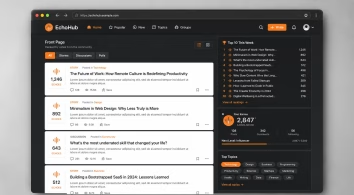
Echodemic — Social Voting Platform on Drupal
Snapshot Industry Social media / Community publishing (USA) What we built A social blogging platform with community voting, karma scores, and an algorithm-driven front page…