
The need for Programmatic SEO: Your Secret Weapon for Scalable Content
January 20, 2025 0 comments
Tired of the Content Creation Grind?
It’s time to grasp some idea about The need for Programmatic SEO!
Imagine this: You’re responsible for an e-commerce website with thousands of products, each requiring its own unique page. Or perhaps you manage a real estate platform with listings scattered across numerous cities. Creating and managing this volume of content manually can feel like an endless uphill battle. This is where programmatic SEO (people started calling it pSEO!) comes in. It’s not just a buzzword; it’s a powerful strategy that can revolutionize your content creation process.
What is Programmatic SEO?
Programmatic SEO is like having an army of tireless content creators at your disposal. Instead of manually crafting each page, you use automation to generate large volumes of unique, high-quality content. Think of it as a sophisticated system that takes your data (product descriptions, location details, etc.) and seamlessly transforms it into engaging web pages.
When to Consider Programmatic SEO
Still unsure if programmatic SEO is right for you? Here are some telltale signs:
Manual Content Creation Nightmare:
-
- Overwhelmed by Volume: Are you spending countless hours creating similar pages with minor variations? For instance, individual pages for each product in your catalog, each service offered in different locations, or each destination covered by your travel site.
- Strained Resources: Is your team struggling to keep pace with the demands of content creation? Are you missing deadlines or sacrificing quality due to limited resources?
- Untapped Data: Do you have valuable data (customer reviews, market research, internal reports) that could be transformed into compelling web content?
Business Model Match:
-
- E-commerce: Ideal for online stores with vast product catalogs. Programmatic SEO can generate unique pages for each product, including variations (size, color, etc.), leading to increased visibility and sales.
- Real Estate: Perfect for platforms with listings across multiple cities or regions. Generate individual pages for each property, highlighting key features and location-specific information.
- Job Boards: Create dedicated pages for each job listing, categorized by industry, location, and experience level, attracting a wider range of applicants.
- Travel: Generate pages for various destinations, incorporating details about attractions, accommodations, and local experiences.
- Service Businesses: Create location-specific pages for businesses operating in multiple areas, highlighting services offered in each region.
- Directories: Automatically generate listings for businesses, organizations, or individuals, ensuring comprehensive and up-to-date information.
A Goldmine of Structured Data:
-
- Product Information: Leverage data like product names, descriptions, specifications, prices, and reviews to create dynamic product pages.
- Location Details: Utilize location data (addresses, maps, nearby amenities) to generate location-specific landing pages.
- Pricing Data: Dynamically update pricing information across your website, ensuring accuracy and transparency.
- Service Descriptions: Create detailed pages for each service offering, highlighting key benefits and features.
- User-Generated Content: Incorporate user reviews, ratings, and testimonials to build trust and social proof.
The Business Impact: Why You Should Care
Programmatic SEO isn’t just about efficiency; it’s about driving tangible business results. Here’s how:
- Reducing Costs: By automating content creation, you can significantly reduce labor costs and allocate resources more effectively.
- Dominating Search Engines: Programmatic SEO allows you to target a vast array of long-tail keywords, increasing your chances of ranking for specific search queries.
- Outpacing Competitors: Scale your content production faster than your competitors, gaining a significant edge in online visibility.
- Ensuring Consistency: Maintain a consistent brand voice and messaging across all your web pages.
- Freeing Up Resources: Empower your team to focus on strategic initiatives, such as content strategy, marketing campaigns, and product development.
How to Get Started with Programmatic SEO
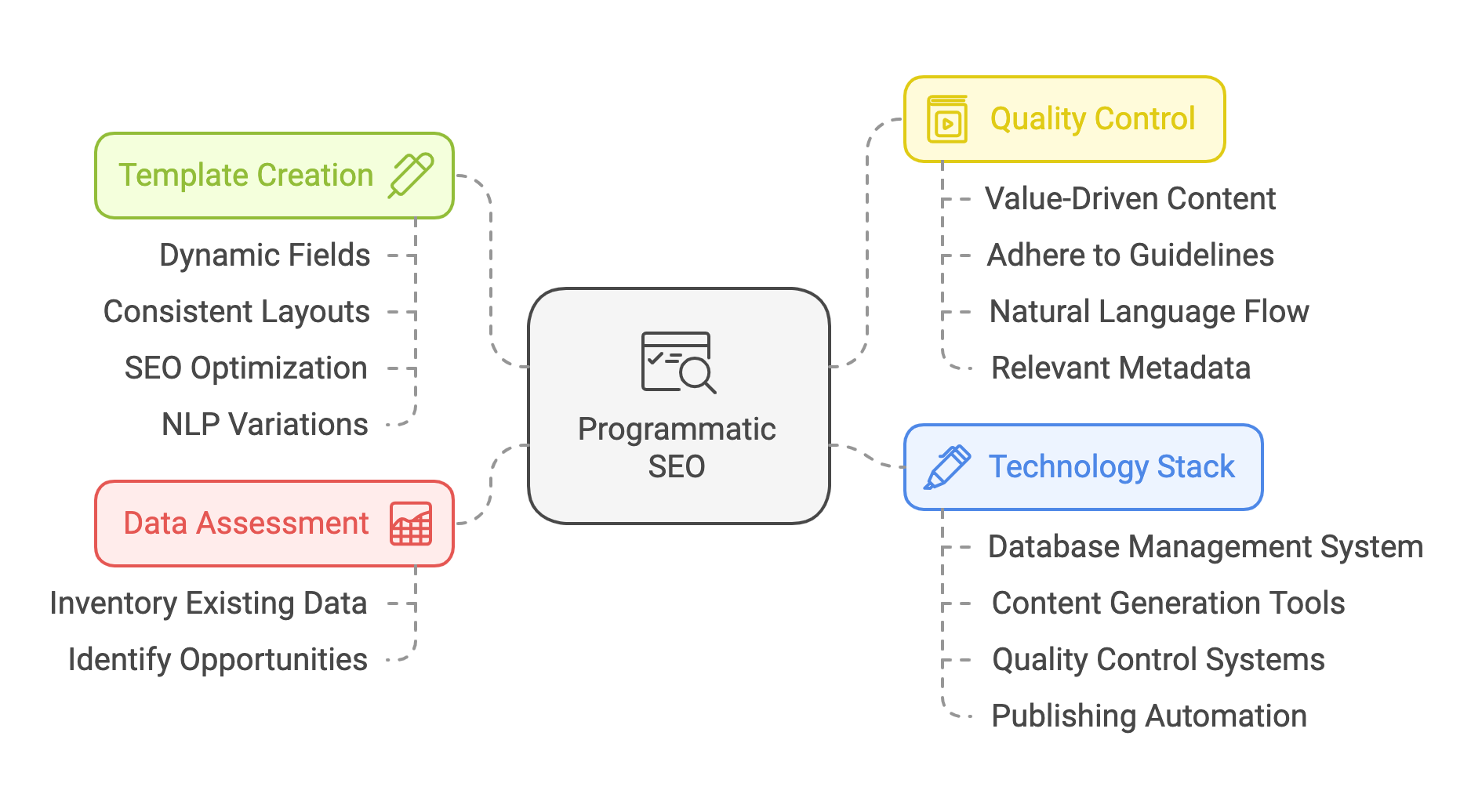
Assess Your Data:
- Take Inventory: Conduct a thorough audit of your existing data sources. This could include customer databases, product catalogs, internal reports, market research, and user-generated content.
- Identify Opportunities: Analyze your data to identify patterns and opportunities for programmatic content creation. For instance, if you have a database of customer reviews, you could use it to generate pages highlighting the most popular products or services.
Create a Template Structure:
- Dynamic Fields: Design templates with dynamic fields that can be populated with data from your database. For example, a product page template might include fields for product name, description, price, and image.
- Consistent Layouts: Ensure your templates follow a consistent layout and design to maintain brand consistency and user experience.
- SEO Optimization: Incorporate SEO best practices into your templates, such as optimized headings, meta descriptions, and image alt text.
- Natural Language Variations: Use natural language processing (NLP) techniques to introduce variations in your content, avoiding repetitive or robotic language.
Implement Quality Control:
- Value-Driven Content: Ensure your automated content provides real value to users. It should be informative, engaging, and relevant to their needs.
- Search Engine Guidelines: Adhere to search engine guidelines to avoid penalties. This includes avoiding keyword stuffing, cloaking, and other black-hat SEO tactics.
- Natural Language Flow: Maintain a natural language flow in your content, making it easy to read and understand.
- Relevant Metadata: Include relevant metadata (title tags, meta descriptions) for each page to improve search engine visibility.
Choose Your Tech Stack:
- Database Management System (DBMS): Choose a robust DBMS to store and manage your data. Popular options include MySQL, PostgreSQL, and MongoDB.
- Content Generation Tools: Select tools that can automate content creation based on your templates and data. Consider platforms like Contentful, Prismic, and Webflow.
- Quality Control Systems: Implement systems to monitor content quality and consistency. This could involve automated grammar and plagiarism checkers, as well as manual review processes.
- Publishing Automation: Utilize tools to automate the publishing process, ensuring your content is seamlessly deployed to your website.
Common Pitfalls to Avoid
- Low-Quality Content: Prioritize quality over quantity. Avoid creating thin, duplicate, or irrelevant content.
- Duplicate Content: Ensure each page has unique content to avoid penalties from search engines.
- Mobile Neglect: Optimize your content for mobile devices, ensuring a seamless user experience across all platforms.
- Internal Linking: Implement a strong internal linking structure to improve website navigation and SEO.
- User Experience: Focus on providing a positive user experience. Your content should be easy to read, navigate, and understand.
A Real-World Success Story
Imagine a local plumbing company serving a large metropolitan area. Initially, they had a single website with basic contact information. By implementing programmatic SEO, they created individual pages for each service (drain cleaning, leak repair, etc.) in every zip code they served. This hyperlocal approach resulted in a 400% increase in organic traffic within six months. Furthermore, by capturing highly specific search queries (“drain cleaning in [zip code]”), they significantly reduced their lead generation costs by 60%. This demonstrates the power of programmatic SEO in driving targeted traffic and business growth.
Is Programmatic SEO Right for You?
Take this quick test to find out:
- Do you need to create more than 50 similar pages?
- Do you have structured data that could be leveraged for content generation?
- Are your target keywords following a pattern (e.g., “best hotels in [city]”?
- Would automating content creation save significant time and resources?
If you answered “yes” to two or more questions, programmatic SEO could be a game-changer for your business.
Next Steps
Ready to embrace the power of programmatic SEO? Here’s how to get started:
- Audit Your Content and Data: Conduct a comprehensive audit of your existing content and data assets.
- Identify Keyword Patterns: Analyze your target keywords to identify patterns and opportunities for programmatic content creation.
- Develop a Template Strategy: Create effective content templates that can be populated with your data.
- Start Small: Begin with a pilot program to test your approach and refine your strategy.
- Scale Based on Results: Gradually expand your programmatic SEO efforts based on the results you achieve.
Remember, programmatic SEO isn’t about quantity; it’s about quality and scale. By leveraging automation, you can create high-quality content efficiently and effectively, driving significant growth for your business.
Related Posts
-
 March 31, 2015
Big Decision about Small Screens: Does your Business Need a Mobile App?
Who hates Mobile phones? We have reached a point in time today where there is no denying that the smartphone boom has taken over the world. A large proportion of internet content consumption, browsing and purchases now happen on mobile devices. They also form a brand opinion and respond
iPhone Development, Mobile development, Welcome0 comments -
 October 20, 2023
Bridging the Gap: The Essential Role of Software Engineering in Web Development
Software Engineering in web development. Reads like a strange phrase? Software Engineering and Web Development are often seen as two different domains. Still, the truth is, the foundations of software engineering are not just academic ideals - they provide the structural integrity to web development projects, too. Here's what you,
