
PrestaShop Agentic Commerce: AI in Every Layer of 9.x
May 10, 2026 0 comments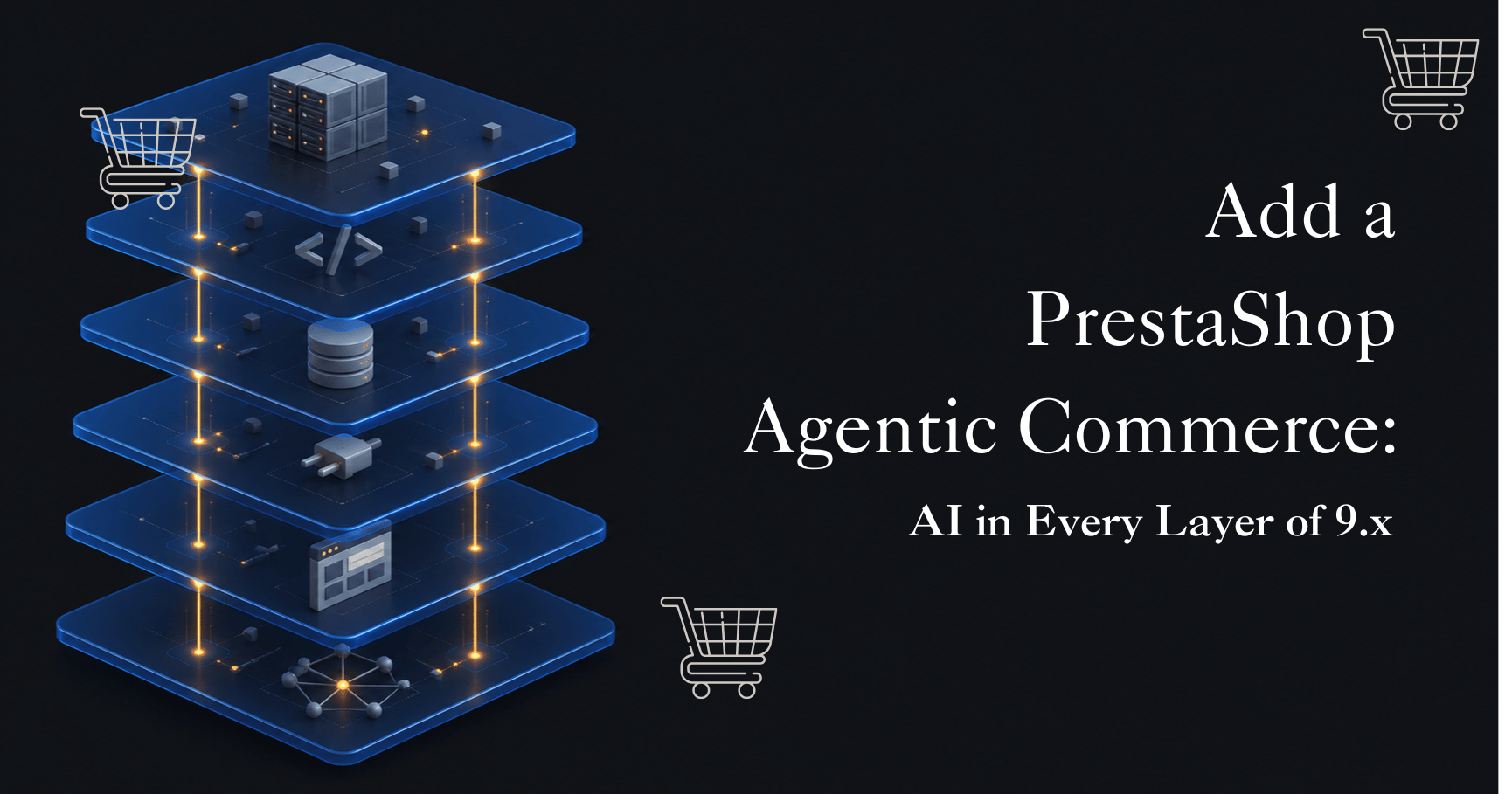
The short answer: PrestaShop 9.0 (June 2025) and 9.1 (March 2026) rebuilt the platform on Symfony 6.4 LTS, PHP 8.1–8.5, and an OAuth2-secured Admin API powered by API Platform 3. For senior developers and agency owners, this is not just a version bump — it is the foundation that finally makes agentic commerce practical on PrestaShop. Every layer of the stack now exposes clean integration points where AI can be embedded as infrastructure, not as a bolt-on widget.
What this post covers
- Why “agentic” is the right frame for PrestaShop in 2026
- The PrestaShop 9.x stack, layer by layer
- Layer 1: Infrastructure — caching, search, observability
- Layer 2: Symfony 6.4 — services, hooks, CQRS
- Layer 3: Data — ObjectModel, Doctrine, and vector stores
- Layer 4: The Admin API — the agentic gateway
- Layer 5: Hummingbird 2.0 — the AEO-ready storefront
- Layer 6: Orchestration — n8n, queues, and autonomous loops
- Legacy vs. agentic: the new service standard
- Where the agency model is heading
- FAQ
Why “agentic” is the right frame for PrestaShop in 2026
For two decades we have sold PrestaShop work the same way: a theme, a set of modules, a payment gateway, and a maintenance retainer. That contract is now obsolete. Merchants are not asking for a “store” anymore — they are asking for a system that operates itself between human decisions. Inventory predictions, support replies, content updates, fraud screening, abandoned-cart sequences, even merchandising calls — these are increasingly handled by autonomous workflows that read from and write to the store.
PrestaShop 9.x is the first version of the platform that makes this honestly possible. The legacy Webservice still works, but the new Admin API ships with OAuth2, JWTs, scoped permissions, CQRS commands, and an OpenAPI spec at /admin-api/docs.json. That is the contract an agent needs in order to act safely. The job of an agency in 2026 is to wire those contracts into orchestration, not to keep patching display: none overrides in a child theme.
The shift is from building stores to building systems that run stores. Every layer of the PrestaShop 9.x stack now has a defensible AI integration point — and senior developers who can identify and wire these layers are the ones who will own the next service contract.
The PrestaShop 9.x stack, layer by layer
Before we talk about AI, we need a shared map of what PrestaShop actually is in 2026. Here is the stack as it ships today, and where each layer sits in a production deployment.
| Layer | What it is | What ships in 9.x |
|---|---|---|
| Infrastructure | OS, web server, database, cache, search | Linux, Apache/Nginx, MySQL 8 / MariaDB, PHP 8.1–8.5 |
| Framework | The PHP framework that runs the back office | Symfony 6.4 LTS (security support to Nov 2027) |
| Data | ORM and persistence | Legacy ObjectModel + Doctrine, coexisting |
| API | How external systems talk to the store | Admin API on API Platform 3, OAuth2, CQRS, plus legacy Webservice |
| Presentation | Front office theme and assets | Hummingbird 2.0 (Bootstrap 5, TypeScript, SCSS/BEM) — default in 9.1 |
| Orchestration | External automation and intelligence | Not core — this is what we add (n8n, queues, vector DB, LLMs) |
Notice the last row. That is where the agency conversation lives now. The first five layers are platform features; the sixth is the layer we get to design.
Layer 1: Infrastructure — caching, search, observability
The infrastructure layer has not changed in shape, but it has changed in expectation. A 2026 PrestaShop store cannot run on a shared LAMP box and meet either Core Web Vitals or the response times an LLM agent expects when polling.
What a production-grade 9.x deployment looks like:
- PHP 8.3 or 8.4 with OPcache and JIT enabled. PrestaShop 9.1 supports up to 8.5, but for production stability 8.3/8.4 is the sweet spot today.
- Redis as the object cache backend — configured in
app/config/parameters.phpviacache_driver. Native PrestaShop support, no module required. - OpenSearch or Elasticsearch for catalog indexing on stores with more than ~10,000 SKUs. The native MySQL fulltext index falls over fast at scale.
- A reverse proxy with edge caching (Cloudflare, Varnish, or Nginx FastCGI cache) for anonymous traffic and product pages.
- Structured logging — Symfony’s Monolog, piped to a log aggregator (Loki, Datadog, or even just a self-hosted ELK stack).
Where AI plugs in at this layer: the moment your logs are structured and centralized, you have an LLM-readable error stream. A nightly n8n job that pulls the last 24 hours of app.ERROR entries, groups them by stack-trace fingerprint, and asks an LLM to triage them is one of the highest-ROI automations you can build for a maintenance client. The output goes into your ticketing system with a draft fix and a confidence score. The human still approves — but they review three triaged tickets instead of three hundred raw errors.
Layer 2: Symfony 6.4 — services, hooks, CQRS
The jump from Symfony 4.4 (PrestaShop 8.x) to 6.4 LTS is the single most consequential change in the platform. It is also the change that breaks the most modules — which is why agency owners need to read this section carefully before quoting any 9.x migration.
Three things every senior dev needs to know:
1. The deprecated controller base class. FrameworkBundleAdminController still works in 9.x but is deprecated and will be removed in PrestaShop 10. Any new admin controller you write should extend PrestaShopAdminController and use proper service injection. Here is the pattern:
|
1 2 3 4 5 6 7 8 9 10 11 12 13 14 15 16 17 18 19 20 21 22 23 24 25 26 27 28 |
<?php namespace MyModule\Controller\Admin; use PrestaShopBundle\Controller\Admin\PrestaShopAdminController; use Symfony\Component\HttpFoundation\Response; use Symfony\Contracts\Service\Attribute\Required; use MyModule\Service\InventoryForecaster; class ForecastController extends PrestaShopAdminController { private InventoryForecaster $forecaster; #[Required] public function setForecaster(InventoryForecaster $forecaster): void { $this->forecaster = $forecaster; } public function indexAction(): Response { $forecast = $this->forecaster->forecastNext30Days(); return $this->render('@Modules/mymodule/forecast.html.twig', [ 'forecast' => $forecast, ]); } } |
2. New module hooks in 9.x. 9.0 and 9.1 added hooks that matter for AI work: actionValidateCartRule (custom rule logic), actionUpdateDefaultCombinationAfter, hooks on module install/disable/upgrade events, and a hook on Configuration::updateValue. The configuration hook in particular lets you push config changes to a central observability layer in real time — useful when an agent is making changes you want auditable.
3. The CQRS pattern. The new Admin API is built on CQRS — every write operation goes through a Command, every read through a Query, and both are dispatched through a CommandBus. This is what lets you intercept any agent action server-side. Want to require human approval for any price change above 20%? Write a CommandBus middleware. Want to log every product write to an immutable audit trail? Same pattern.
CQRS is the single feature that separates “AI as a chatbot widget” from “AI as a trusted operator.” It gives you a single chokepoint to enforce policy on every write, regardless of whether the request came from the back office, the API, or an autonomous agent.
Layer 3: Data — ObjectModel, Doctrine, and vector stores
This is the layer where most agencies will get tripped up, because the picture is not clean. PrestaShop 9.x is in the middle of a multi-year migration from the legacy ObjectModel pattern to Doctrine ORM. Both exist. Both are used by core. Modules can use either, and the documentation is actively evolving.
The pragmatic guidance for 2026:
- For anything new, prefer Doctrine. Entities, repositories, migrations, and the QueryBuilder — this is the path the core team is moving toward, and it gives you safer schema evolution.
- For legacy compatibility, ObjectModel is fine. If you are extending or hooking into a class that still uses ObjectModel (and most still do), match the pattern. Mixing ORMs in one feature is a maintenance hazard.
- Stop running
SQLagainst the DB directly. Both ORMs run validators, hooks, and event listeners. Direct queries skip all of that, and you will pay for it during the next upgrade.
The new piece: a vector store alongside MySQL. Once you decide to add semantic search, AI-generated product descriptions, or RAG-based support, you need somewhere to keep embeddings. Three honest options:
| Vector store | When to choose it | Trade-off |
|---|---|---|
| pgvector on PostgreSQL | You are willing to run a second DB just for embeddings | Best-in-class control, but you are now operating two databases |
| MySQL 8.4+ vector type | You want everything in MySQL and have modest scale | Native, simple — but performance lags dedicated stores at high recall |
| Managed (Pinecone, Weaviate, Qdrant Cloud) | You want zero ops and predictable latency | Recurring SaaS cost; data lives off your infrastructure |
For most mid-market PrestaShop merchants we work with, the answer is a managed vector store keyed by id_product, refreshed via an n8n cron that listens to the actionProductUpdate hook. Embeddings are cheap; rebuilding the wrong architecture is not.
Layer 4: The Admin API — the agentic gateway
This is the layer that changes the game. Every conversation about agents, automation, or AI integration in PrestaShop 9.x comes back to the Admin API. Get this layer right and the rest follows.
What the Admin API actually is:
- Built on API Platform 3, running through a dedicated
AdminAPIKernelseparate from the back-office UI kernel. - Authenticated via OAuth2 client credentials grant. Every client gets a
client_id+client_secret, exchanged for a JWT access token at/admin-api/access_token. - Authorization is scope-based:
product_read,product_write,order_read,customer_group_write, and so on. Every endpoint declares its required scope; tokens carry granted scopes; mismatches return 403. - Endpoints follow the CQRS pattern on the server side — the API surface is REST/JSON, but every write dispatches through a Command.
- Auto-generated OpenAPI spec at
/admin-api/docs.json, importable into Postman, Insomnia, or any OpenAPI-aware code generator. - The legacy Webservice (XML, Basic Auth, broader resource coverage) is not deprecated and runs in parallel.
The OAuth2 handshake — this is the request your agent will make every hour or so to refresh its token:
|
1 2 3 4 5 6 7 8 9 10 11 12 13 |
curl -X POST 'https://your-store.com/admin-api/access_token' \ -H 'Content-Type: application/x-www-form-urlencoded' \ -d 'grant_type=client_credentials' \ -d 'client_id=YOUR_CLIENT_ID' \ -d 'client_secret=YOUR_CLIENT_SECRET' \ -d 'scope=product_read product_write hook_read' # Response: # { # "token_type": "Bearer", # "expires_in": 3600, # "access_token": "eyJ0eXAiOiJKV1Qi..." # } |
That JWT is what your n8n workflow, your CRM sync, or your support agent uses for the next hour. Renew before it expires; never store secrets in module code; always use HTTPS in production (TLSv1.2 is enforced unless debug mode is on).
Three agentic patterns the Admin API enables:
Pattern 1: Read-only intelligence agents. Scope a token to product_read order_read customer_group_read and you have an agent that can answer “what is selling, to whom, and what is sitting in stock.” Connect it to a Slack bot or an internal dashboard. No write risk.
Pattern 2: Write-with-approval agents. A second agent has product_write scope but every command it dispatches goes through a CommandBus middleware that checks a policy.yaml — price changes over a threshold, stock changes over a quantity, or any change to a product flagged as “human-only” gets queued for approval instead of executed.
Pattern 3: Closed-loop autonomy. For narrow, well-defined tasks (regenerating meta descriptions, updating WebP images, tagging products, draft translations), an agent runs end to end without human approval but every action writes to an audit log keyed by the JWT’s jti. If something goes wrong, you can revoke the client and replay the audit log to find what changed.
Layer 5: Hummingbird 2.0 — the AEO-ready storefront
PrestaShop 9.1 made Hummingbird 2.0 the default front office theme, and this matters more than agencies are giving it credit for. The old Classic theme was, frankly, a Core Web Vitals liability. Hummingbird is built on Bootstrap 5, TypeScript, and SCSS with BEM — modern, lean, and shipped with over 95% compliance with the European Accessibility Act.
For agentic commerce, the relevant Hummingbird features are:
- Native WebP and AVIF support — serving modern image formats without a third-party module.
- Proper structured data hooks in the templates, so adding Product, Offer, FAQPage, and BreadcrumbList JSON-LD is a Twig override, not a regex hack.
- Cleaner SEO URLs — product URLs without the category prefix are now a configuration toggle, and configurable redirects ship in core.
- BEM-class structure means an LLM scraping your own site for embeddings can reliably extract product attributes from the DOM.
Where AI plugs in at this layer: the practical 2026 work is Answer Engine Optimization. Generative search engines (Google’s AI Overviews, ChatGPT search, Perplexity, Gemini) cite structured, well-marked-up product data. The pattern we recommend is a weekly job that audits your top 200 products, generates schema-complete descriptions and FAQ blocks via an LLM, validates the JSON-LD, and pushes via the Admin API. We are productizing this as a service line through 2026 and the Hummingbird theme is what makes the rendered output trustworthy enough for the citations to land.
Layer 6: Orchestration — n8n, queues, and autonomous loops
This is the layer that does not ship with PrestaShop, and it is where the agency value lives. The orchestration layer is whatever sits between the Admin API, your LLM provider, your vector store, and your other business systems (CRM, ERP, email, ticketing).
For most of our clients we use n8n. It is self-hostable, has a 600+ node integration library, and crucially supports the workflow-as-code pattern that lets us version-control every automation in the same repo as the module. Other defensible choices: Temporal for hard durability requirements, Make.com for non-technical merchants, or a custom Symfony Messenger setup if you want everything in-house.
Five autonomous loops that pay for themselves on a typical mid-market store:
- Inventory forecasting loop. Pull 90 days of orders via Admin API ? time-series forecast (Prophet or an LLM with tool use) ? write recommended reorder quantities back as product metadata for the buyer to approve.
- Self-healing error triage loop. Watch
app.ERRORstream ? group by stack-trace fingerprint ? LLM drafts hypothesis + suggested fix ? posts to Linear/Jira with priority score. - Abandoned-cart sequence loop. Cart abandonment hook ? LLM generates a personalized recovery email (using product attributes + customer history) ? sends via your ESP ? tracks reply for sentiment.
- Content freshness loop. Weekly scan of low-traffic product pages ? LLM rewrites meta description and intro paragraph using current keyword data ? writes via
product_writescope, flagged for review if confidence is below threshold. - Fraud screening loop. New order hook ? enrichment via IP/email/device ? LLM risk classification with reasoning ? auto-hold or auto-approve based on policy, manual review queue for the middle band.
These are the five loops we evaluate first when scoping an agentic build for a PrestaShop merchant. Some are in client production today, others are patterns we are actively prototyping and productizing as standard service offerings through 2026. The differentiator across all of them is not whether you can build them — the modules and APIs are there. It is whether you can build them with the audit trails, scope hygiene, and rollback paths that let a merchant trust an agent to act on their store. That discipline is what separates a working demo from a system a CFO will sign off on.
Legacy vs. agentic: the new service standard
Here is the comparison table that should drive your next sales conversation. If your maintenance retainer still looks like the left column, you are competing on price. If it looks like the right column, you are competing on outcomes.
| Capability | Legacy approach (PrestaShop 1.7 / 8.x era) | Agentic approach (PrestaShop 9.x standard) |
|---|---|---|
| Framework | Symfony 4.4, PHP 7.x, FrameworkBundleAdminController | Symfony 6.4 LTS, PHP 8.3+, PrestaShopAdminController + service injection |
| API surface | Legacy Webservice, XML, Basic Auth, broad resource coverage | Admin API on API Platform 3, JSON, OAuth2 + JWT, scope-based access |
| Data architecture | ObjectModel, MySQL fulltext search | Doctrine + ObjectModel coexistence, MySQL + vector store, OpenSearch for catalog |
| Search experience | Keyword + filters | Hybrid keyword + semantic vector search with intent understanding |
| Automation | Cron-driven SQL scripts and stock syncs | n8n workflows, CQRS-mediated agent writes, audit-logged autonomous loops |
| SEO posture | On-page keyword optimization, basic schema | AEO — complete JSON-LD, FAQPage schema, structured product graph for LLM citation |
| Maintenance retainer | Reactive: bug tickets, module updates, security patches | Proactive: agent-triaged errors, automated content freshness, forecast-driven ops |
Where the agency model is heading
If you are running an agency that supports PrestaShop, here is an honest map of the capabilities the next service contract will increasingly assume. Most agencies — including good ones — are at two or three of these today. That is fine. The point of the list is not to score yourself; it is to make the direction of travel concrete so you can plan investment.
- Every client store on PrestaShop 9.0 or 9.1, or a documented migration plan with timeline.
- Custom modules using
PrestaShopAdminControllerrather than the deprecated base class. - An Admin API client set up with the minimum required scopes for at least one automation.
- Redis configured for object cache on every production store you maintain.
- Structured logging piped to a central aggregator, not just
var/logs/on each server. - A decision on a vector store and at least one embedding pipeline written.
- A working n8n (or equivalent) instance with version-controlled workflows.
- At least one autonomous loop in production that demonstrably saves the merchant time.
- An audit log keyed to JWT
jtifor every agent-driven write. - AEO citations measured alongside traditional SEO rankings in your client reports.
The honest read in 2026: very few agencies tick more than half of these. The ones who tick seven or more in 2027 are the ones who will be writing six-figure agentic-commerce retainers. The ones who keep selling theme tweaks and module installs will still have work, but they will be competing on price.
The bottom line
PrestaShop 9.x is the first version of the platform where agentic commerce stops being a marketing phrase and becomes a buildable architecture. The Admin API gives you the safe gateway. Symfony 6.4 and CQRS give you the policy enforcement layer. Doctrine and a vector store give you the data foundation. Hummingbird gives you the AEO-ready storefront. n8n (or your orchestrator of choice) is where it all wires together.
The agency owners who are going to win the next decade are the ones who stop selling “PrestaShop development” and start selling autonomous commerce systems with PrestaShop at the core. The platform finally supports it. The merchants are finally asking for it. The only question is whether your team has internalized the layers above well enough to architect for it.
FAQ
Is PrestaShop 9.x stable enough for production migrations in 2026?
Yes. PrestaShop 9.0 went GA in June 2025 after nearly two years of alpha and beta testing, and 9.1 followed in March 2026. The core is stable. The catch is module and theme compatibility — many third-party modules still need updates for Symfony 6.4 and the new API. Always run the Update Assistant 7 in staging before migrating a live store, and budget time for replacing modules that are not yet 9.x-compatible.
Should I use the new Admin API or the legacy Webservice?
For new integrations on PrestaShop 9.x, use the Admin API — OAuth2, JSON, and scope-based access are the right primitives for agentic work. For backward compatibility with PS 1.7 / 8.x stores, or for resources the new API does not yet cover, the legacy Webservice still works and is not deprecated. Many production integrations end up using both, and that is fine.
Do I need a vector database to do AI work on PrestaShop?
Not for everything. You can call an LLM directly from an n8n workflow without any vector store at all. You only need vector storage when you are doing semantic search, retrieval-augmented generation over your own catalog, or recommendation work that depends on similarity. For most mid-market merchants, the right starting point is one or two LLM-powered automations with no embeddings, then add a vector store when a specific feature requires it.
Is Hummingbird 2.0 mandatory in PrestaShop 9.1?
It is the default for new installations, but existing stores upgrading from 9.0 keep their current theme. You can stay on Classic, port your customizations to Hummingbird 2.0, or build a custom theme on its framework. For new builds in 2026, starting on Hummingbird 2.0 is the right call — the Core Web Vitals and accessibility improvements alone justify it.
What is the realistic timeline to convert a maintenance contract from “legacy” to “agentic”?
Three to six months for a typical mid-market client. Month one is migration to 9.x and infrastructure hardening (Redis, structured logging). Months two and three cover the first automation (usually error triage or abandoned cart). Months four through six are when you layer in vector search, AEO content automation, and the audit-trail discipline that makes the merchant trust agent writes. Trying to do all of it in a single sprint will burn out your team and your client’s patience.
How does Answer Engine Optimization (AEO) differ from traditional SEO for an e-commerce store?
Traditional SEO optimizes for ranked links on a search results page. AEO optimizes for being cited by generative answer engines — ChatGPT search, Google’s AI Overviews, Perplexity, Gemini. The mechanics overlap (clean structured data, fast pages, authoritative content), but the deliverables differ. AEO leans heavily on complete JSON-LD product schema, FAQPage schema for category and product pages, and content that directly answers the questions customers actually ask. We treat AEO as a service line, not a checkbox inside SEO.
Can I run autonomous agents that write to my store without human approval?
Technically yes — OAuth2 scopes and CQRS make it safe to do for narrow, low-risk tasks (image format conversion, meta description regeneration, tag normalization). For anything affecting price, stock, customer data, or order state, run a CommandBus middleware that requires human approval above defined thresholds. The right architecture is “autonomous by default, gated by policy” — not “either everything or nothing.”
Where Macronimous stands on this
One honest paragraph, because senior buyers see through marketing copy faster than anyone. Macronimous has been building on PrestaShop since the platform’s earliest commercial releases — we have shipped stores across PS 1.4 through 9.x. We are actively investing in the agentic patterns described in this post: some are already in client production, others are templates we are productizing through 2026 as standard service offerings. We do not pretend to have all of this perfectly solved, because nobody does in April 2026 — the platform itself is less than a year past 9.0 GA. What we do have is two decades of PrestaShop work, a team that reads the Symfony and API Platform changelogs as part of the day job, and a willingness to tell a merchant when a feature is not yet ready for their use case. If you are evaluating this architecture for your store, we are happy to share what has worked, what has not, and where the real costs live.
Planning a PrestaShop 9.x migration or an agentic commerce build?
Macronimous has been delivering PrestaShop development since the platform’s earliest releases. We help agency owners and merchants migrate to 9.x, harden the stack, and design the orchestration layer that turns a store into a system. Talk to us about your roadmap.
Related Posts
-
 March 30, 2024
Unlocking Success: The Ultimate Guide to PrestaShop Permalinks
A well-structured online store is paramount for attracting and retaining customers. But beyond a visually appealing layout, there's a crucial element that often goes unnoticed: the permalink. If you are a PrestaShop developer, We will explain PrestaShop Permalinks in full length. This seemingly simple term holds immense power when it
PrestsShop Development, CMS, Google SEO, SEO, Technical SEO0 comments -
 August 31, 2025
Unlocking Advanced PrestaShop Development: 5 Key Strategies for Agencies
If you are a PrestaShop developer looking for some Advanced PrestaShop Development tips, this blog is for you. PrestaShop is a powerful e-commerce platform, and while getting started is relatively straightforward, mastering its intricacies can significantly elevate your development capabilities. If you're looking to move beyond the basics and build
