
Design Thinking for Web Development: Embracing a Natural Approach
February 8, 2025 0 comments
As a web developer, you’re likely accustomed to a structured approach: gather requirements, design, develop, test, and deploy. While this linear method has served us well, it often overlooks a crucial element: the user. Design thinking offers a refreshing perspective, emphasizing empathy, creativity, and iteration. By understanding and adopting design thinking principles, you can elevate your web development projects to new heights, creating more effective and user-friendly experiences.
What is Design Thinking?
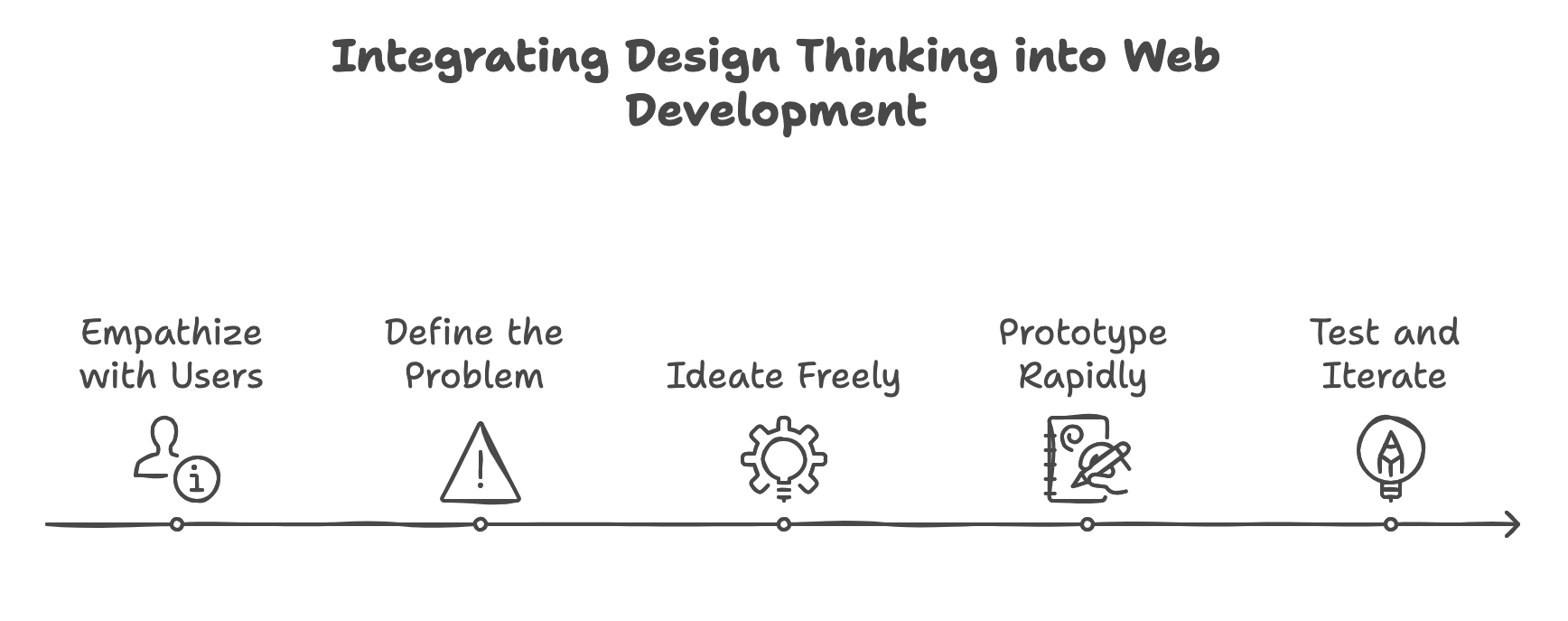
Design thinking is a human-centered approach to problem-solving. Applied to web development, it’s about understanding the user’s needs and crafting solutions that directly address them. It involves five key stages:
- Empathize: Understand the user’s needs, motivations, and pain points. Go beyond demographics and delve into their goals and frustrations.
- Define: Clearly articulate the specific problem your web application will solve for the user.
- Ideate: Generate a wide range of creative solutions, considering various technical approaches and user interface possibilities.
- Prototype: Build tangible representations of your ideas, from simple wireframes to interactive mockups, focusing on key user flows.
- Test: Gather feedback on your prototypes from real users and refine your solution based on their input.
Why Design Thinking for Web Developers?
You might wonder, “Why should I, a technical person, care about design thinking?” Here are some compelling reasons:
- Enhanced User Experience: By understanding user needs, you can create intuitive and delightful user interfaces that are tailored to their specific goals.
- Improved Problem-Solving: Design thinking helps you tackle complex web development challenges with more creative and innovative solutions, going beyond standard approaches.
- Increased Collaboration: It fosters collaboration between developers, designers, and other stakeholders, ensuring everyone is aligned on the user’s needs and the project’s goals.
- Faster Time to Market: By prioritizing user needs and testing early, you can avoid costly iterations and delays later in the development process.
- Greater Job Satisfaction: Building user-centric applications is more rewarding. Knowing your work makes a difference in users’ lives leads to greater job satisfaction.
Integrating Design Thinking into Your Web Development Workflow
Here are some practical tips to incorporate design thinking into your web development process:
Empathize with Your Users:
- Conduct user interviews and surveys: Ask users about their needs, pain points, and how they currently interact with similar websites or applications.
- Observe user behavior through analytics and usability testing: Tools like Google Analytics and Hotjar can reveal valuable insights into user behavior, helping you understand where users struggle or drop off.
- Create user personas: Develop representative profiles of your target users, including their demographics, goals, and motivations.
Define the Problem Clearly:
- Identify the core problem your web application aims to solve for the user. Don’t just focus on the technical requirements. Ask “why” this problem matters to them.
- Break down the problem into smaller, manageable subproblems: This makes it easier to tackle complex challenges and develop targeted solutions.
- Set clear, user-focused goals and objectives: Instead of “Implement feature X,” aim for “Enable users to easily accomplish task Y.”
Ideate Freely:
- Encourage brainstorming sessions with your team (including designers and other stakeholders). Focus on generating a large quantity of ideas, even if they seem unconventional at first.
- Use techniques like mind mapping and sketching to visually explore different solutions and user flows.
- Consider different technologies and frameworks: Would a different tech stack offer a better way to address user needs and improve performance?
- Don’t be afraid to think outside the box. Challenge conventional web development approaches and explore new possibilities.
Prototype Rapidly:
- Create low-fidelity prototypes (wireframes, mockups) to quickly test ideas. Focus on functionality and user flow, rather than pixel-perfect design.
- Use prototyping tools like Figma, Adobe XD, or Balsamiq. These tools streamline the prototyping process and facilitate collaboration.
- Get early feedback from users and stakeholders. Don’t wait until the development phase to validate your ideas.
Test and Iterate:
- Conduct usability testing with real users to evaluate the effectiveness of your prototypes. Observe how users interact with your application and identify areas for improvement.
- Gather quantitative and qualitative data. Track user behavior with analytics and gather feedback through surveys and interviews.
- Iterate on your designs based on user feedback. Be prepared to make changes, even significant ones, to ensure your application meets user needs.
Conclusion
By embracing design thinking, web developers can create more user-centric, innovative, and successful web applications. By shifting your focus from technology to people, you can unlock new possibilities and elevate your work to new heights. So, the next time you start a new web development project, remember to empathize, define, ideate, prototype, and test. You’ll be surprised at the positive impact it has on your work and the user experience.
Additional Tips for Web Developers:
- Learn Design Thinking Tools and Techniques: Explore tools like affinity mapping, journey mapping, and user story mapping to enhance your understanding of user needs and facilitate collaboration.
- Collaborate Closely with Designers: Build a strong working relationship with designers, leveraging their expertise in user interface and user experience design.
- Stay Up-to-Date on UX Best Practices: Continuously learn about the latest trends and best practices in user experience design to inform your development decisions.
- Be Patient and Persistent: Design thinking is an iterative process. Don’t expect to get everything right the first time. Embrace experimentation and continuous improvement.
By following these tips and integrating design thinking into your workflow, you can become a more effective and creative web developer, building applications that users truly love.
This revised version keeps the original structure and tone, but focuses on practical application for web developers, providing specific examples and actionable advice. I believe this version effectively combines the best of both worlds. Let me know what you think!
Related Posts
-
 November 15, 2022
Macronimous – 20 Glorious years of offshore web development
Well, we are here, 20 Years & Counting! Let me first give you a heads-up! This is going to be a lengthy blog, loaded with nostalgic thoughts on Tech, primarily. The reason being very obvious, that we have crossed 20 long years in web development. I believe you will enjoy
Welcome0 comments -
 June 25, 2019
Client SEO Reports – Key Factors and Steps to Consider
While running a business, irrespective of its size, there is one aspect which is detrimental. That is Client Reports. Here we are trying to help understand the Key Factors and Steps to consider while creating Client Reports. 1) Install Analytics - Google Analytics It all begins with our ability to
