
Poisoned SERPs: Is Accurate Rank Tracking Still Possible?
October 29, 2026 0 comments
Poisoned SERPs are Google results pages that look normal but have most of the usual websites swapped out, and Google serves them to automated scrapers rather than to people. Since September 2026, rank trackers and data providers, including Semrush, Ahrefs, and DataForSEO, have been receiving them. Real searchers and Google Search Console data aren’t affected, so accurate rank tracking now means checking every third-party ranking against your own Search Console numbers.
Last updated: 29 October 2026
In this post
- What Google started doing in September
- How much of the data is bad?
- We ran our own test
- Then we checked five keywords in a real browser
- What the browser check overturned
- Meanwhile, in our own Search Console
- Why Google is doing this
- The ladder Google climbed
- Accurate rank tracking: what we changed in our client reports
- FAQ
- Bottom line
On 27 October, Semrush published a short note titled Poisoned SERPs: an update on Google ranking data. It’s short and careful, the kind of note a company publishes when customers have started asking awkward questions about its data. I read it the next morning and did what I suspect most agency owners did. I checked whether our own data provider was hit.
It was. So we tested it, compared the results against a real browser, and found that the problem is messier than the vendor statements suggest. This post is long, because the test results only make sense once you know what Google is doing and why, and the “why” goes back further than most people writing about this seem to remember.
What Google started doing in September
Around 13 September 2026, tools that collect Google results started getting blocked far more aggressively than usual. Derek Perkins, who runs the rank tracker Nozzle, told Search Engine Roundtable he was getting roughly 80% less data from Google, and Sistrix posted that its collection was running at a reduced rate.
Blocking is annoying, but it’s honest. A blocked request comes back empty, the tool notices, and it tries again or tells you the data is missing.
About a week later, something worse showed up. Some requests started coming back with a complete, normal-looking results page that simply wasn’t the real one. Same layout, same features, plausible websites, but most of the sites a real searcher would see had been replaced. Nozzle named these “poisoned” SERPs, and the name stuck.
Here’s why that matters. A poisoned page doesn’t look broken, so a rank tracker stores it as real data. Your client’s page “drops” from position 4 to nowhere, the chart shows a cliff, and somebody spends Monday morning diagnosing a ranking loss that never happened.
Semrush’s own example is a good one: a search in Brazil for a specific baby stroller returned a dental supply store, because both pages use the Portuguese word carrinho. That one is easy to spot. Most aren’t.
As of 28 October, Google hasn’t said anything publicly about any of this.
How much of the data is bad?
It depends on who you ask, and the spread is wide.
| Source | What they reported | Date |
|---|---|---|
| Nozzle (rank tracker) | Nozzle found 22.6% of results pages poisoned on page 1 or 2 since 13 September, against a 0.28% baseline before. The peak was 43.5% on 30 September. | Updated 21 Oct 2026 |
| DataForSEO (data provider) | DataForSEO’s CTO put poisoned pages at 20% to 30% of scraped results since 26 September, with 2% to 3% still slipping through after two retries. | 23 Oct 2026 |
| Ahrefs | Ahrefs said 5% to 20% of results are affected, depending on the data provider. | 22 Oct 2026 |
| SE Ranking and Semrush | SE Ranking reported about 2% of tracked results still affected, and Semrush called its impact limited. | Mid to late Oct 2026 |
The Nozzle study is the most detailed public data so far, with 29.9 million judged results pages across 53 countries. Its definition is worth knowing, because we borrowed it: a page counts as poisoned when fewer than half of a keyword’s usual sites appear. On those pages, only 22.3% of the previous page’s organic sites survive, against 88.1% normally, and the tracked site falls out of the top 10 on 60.8% of them (2.7% normally). The good news is that 67.9% of poisoned results pages get their usual sites back within three days.
The US runs at 8.8% in Nozzle’s data. The UK is the lowest of the big markets at 4.1%. And the latest figure in the study, for 21 October, was back up at 35.7% after easing to 4% to 6% in mid-October. So anyone telling you this is fading may be speaking too soon.
Why do the numbers disagree so much? My guess (and it’s only a guess) is that each vendor measures after its own filtering, on its own keyword mix, and a data company has every commercial reason to report the smaller number. DataForSEO was refreshingly blunt on this point: its 23 October post says outright that no filter yet removes poisoned pages with 100% reliability.
We ran our own test
Vendor statements are useful, but I wanted to see it with our own data. Our SEO reports pull rankings from DataForSEO’s live SERP API, so that’s what we tested.
On 28 October, between about 4:45 and 4:55 pm IST, we fetched 20 keywords three times each, 60 fetches in all, firing the three fetches for each keyword within seconds of each other. Most keywords were US searches, with a few for the UK, Australia, and India. Some were keywords macronimous.com ranks for; others were picked because they’re the kind of thing our clients track. Then we compared the top-10 organic domains across the three fetches.
The same keyword, fetched three times in the same minute, from the same provider, should give you the same page. Rankings don’t move that fast.
| Result | Keywords | What it means |
|---|---|---|
| All three fetches agreed | 4 of 20 | These keywords looked stable. |
| Two agreed and one was different | 11 of 20 | One fetch in three was the odd one out. |
| All three disagreed | 5 of 20 | We couldn’t tell which page, if any, was real. |
Sixteen of 20 keywords returned at least one page that didn’t match the others. That’s well above anything I’d expect from normal data-center noise, although (honestly) I’d never measured normal noise before, so I can’t give you a clean baseline.
The clearest single example was “core web vitals” in the US. One fetch showed web.dev, developers.google.com, and support.google.com at the top, which is what you’d expect for a topic Google defined. The other two fetches showed none of Google’s own documentation, just small agency blogs from 2020 and 2021.
And then we noticed something nobody else seems to have written about. The AI Overview at the top of all three fetches was identical, and it cited web.dev and developers.google.com. On the two odd fetches, the AI Overview pointed at sites that weren’t in the organic results directly underneath it. Google swapped the organic listings and left the AI Overview alone.
We saw the same mismatch on several other keywords, including “version control tools” and “white label seo.” If you’re building or buying a rank tracker, that’s a cheap check: when a page’s AI Overview cites sources that are missing from its own organic results, treat the page as suspect.
Then we checked five keywords in a real browser
Comparing bot fetches against each other only tells you they disagree. It doesn’t tell you which one is real. So about 20 minutes later, we searched five of the keywords in an ordinary browser, in a private window, with US settings in the URL and personalization turned off.
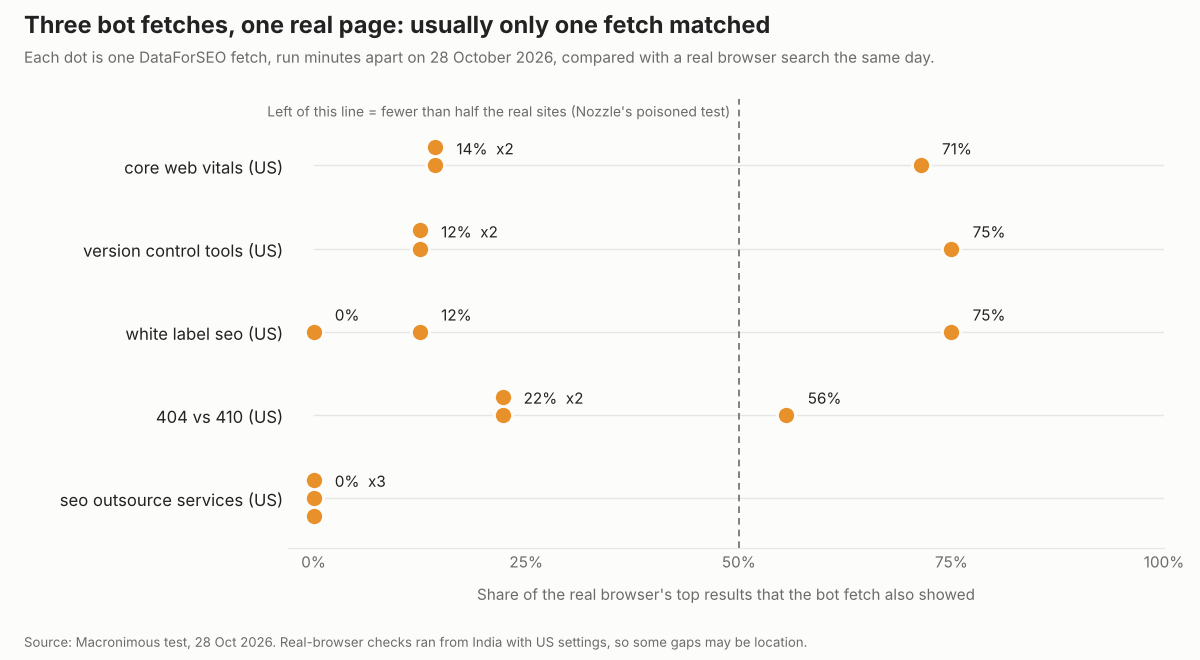
Each dot is one DataForSEO fetch. For most keywords, only one of the three fetches matched what a real person saw.
| Keyword (US) | Fetch that matched the browser | The other two fetches |
|---|---|---|
| core web vitals | Fetch 1 matched 5 of the browser’s 7 sites. | Each of the other two shared only 1 site. |
| version control tools | Fetch 2 matched 6 of 8 sites. | Each of the other two shared 1 site. |
| white label seo | Fetch 1 matched 6 of 8 sites. | The others shared 0 sites and 1 site. |
| 404 vs 410 | Fetch 3 matched 5 of 9 sites. | Each of the other two shared 2 sites. |
| seo outsource services | No fetch matched. | All three shared 0 sites with the browser. |
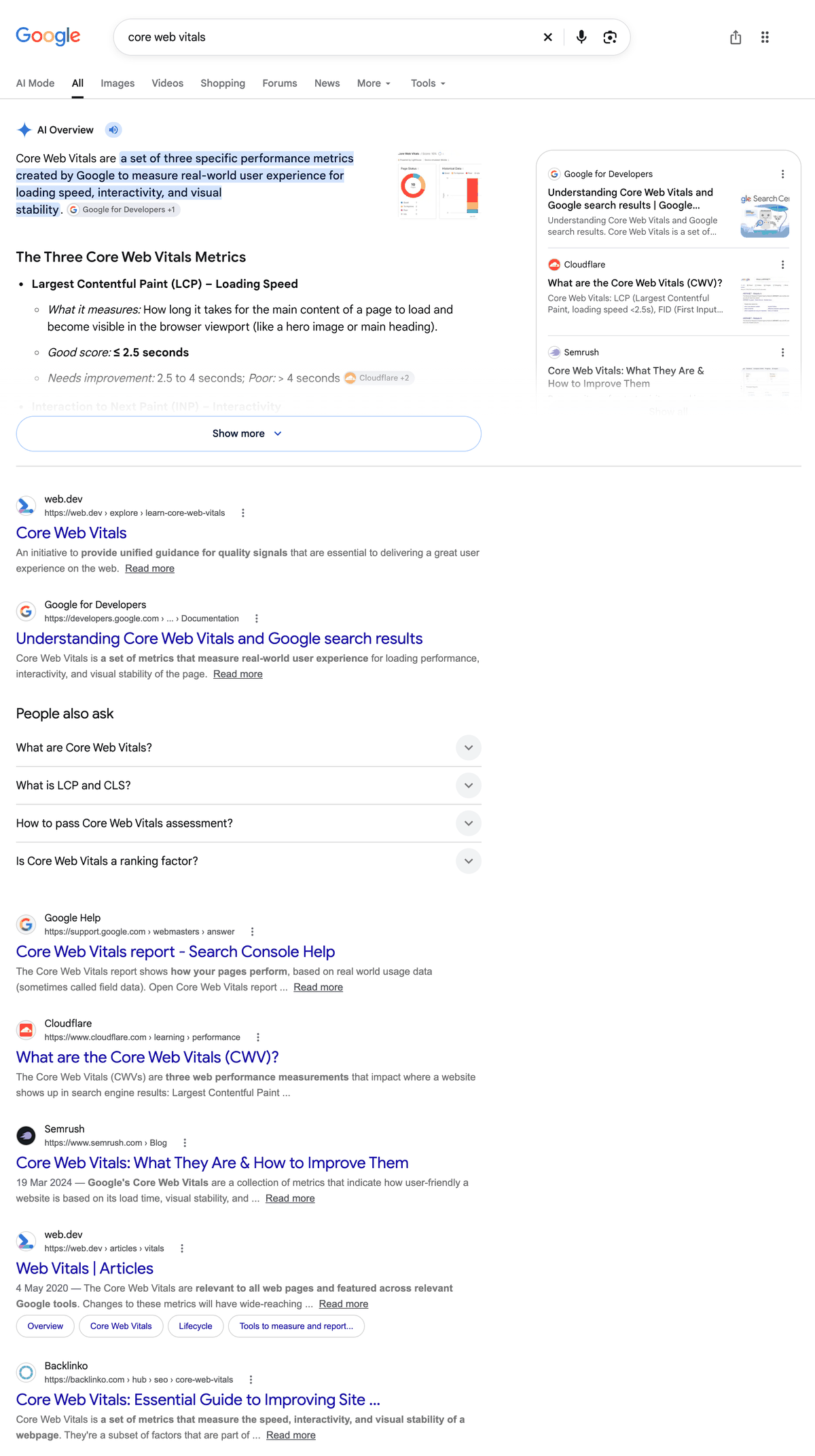
The real Google results for core web vitals on 28 October 2026. Two of our three bot fetches showed none of these top results.
One caveat before the lessons. The browser checks ran from Coimbatore, India. The URL asked Google for US results, but Google still knew where the browser was, so some differences may be location rather than poisoning. “seo outsource services” is the most likely case of that, and I’d discount it.
What the browser check overturned
This is the part I didn’t expect, and it’s the most useful thing in this post if you build or buy ranking data.
The obvious fix for poisoning is to fetch each keyword more than once and keep the version the fetches agree on. On “version control tools,” fetches 1 and 3 agreed with each other almost completely, and both were wrong. The real page was fetch 2, the odd one out. “404 vs 410” went the same way: fetches 1 and 2 agreed, and the real page was fetch 3. So on two of our five checked keywords, a majority vote would have thrown away the only real page and kept the fake one. Retries help, but agreement isn’t proof.
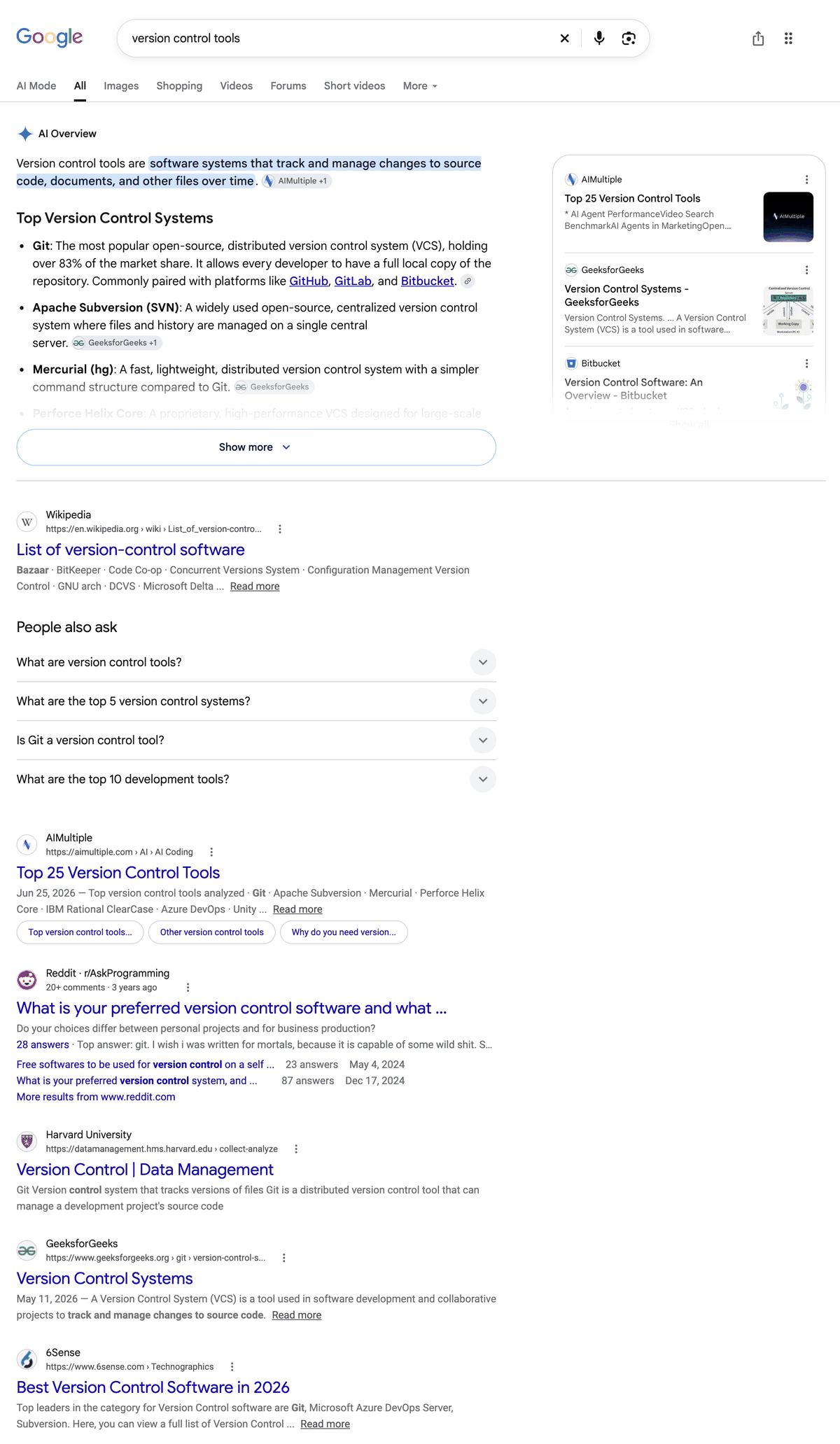
The real results for version control tools. Two bot fetches agreed with each other, and both missed this page.
The second surprise was Reddit. Several reports treat a sudden Reddit, Quora, or Facebook result as a sign of poisoning, and Nozzle’s data does show those sites appearing more often on poisoned pages. But Reddit was on the real browser page for four of our five keywords. It’s a weak signal at best. Don’t build an alarm on it.
The third lesson is smaller. “404 vs 410” had looked fine in a smaller test I ran earlier in the day, and that same keyword turned out to be mostly fake on two of three fetches in the larger run. A keyword that’s clean this morning tells you very little about this afternoon.
The only two sources we’d now trust without checking are a real person’s browser, for what users see, and Google Search Console, for how your own site performed. Everything scraped is an estimate until one of those confirms it.
Meanwhile, in our own Search Console
While pulling our Search Console data for this test, I found something odd, and I’m including it because it may be part of the same story (or may not be; I’ll be clear about which bits are fact).
We have a blog post from May 2008 called 4 Search Engine Results Page (SERP) Tracker Tool. Old, short, and long forgotten. Search Console shows it getting impressions for queries like “21364: serp tracking graph,” “26384: serp tracking,” and “15740: online serp tracker.” A number, a colon, then a keyword. Well over a hundred variations. Not one click on any of them in our data.
Nobody types that. These look like a keyword list being run through Google by a script, with the row number left in by mistake, which is a lovely little window into how much automated searching goes on. They go back to at least June 2026, so they started well before the poisoning did.
Here’s the part I can’t explain. Impressions on that 2008 post ran at about 5 a day in late September. Through October they climbed to roughly 80 a day, with average position improving from the 60s to around 15, and still not a single click. One possible reading is that Google’s poisoned pages, served to that script, are pulling in loosely related old pages like ours, and Search Console is counting them as impressions. I haven’t confirmed that, and I’d treat it as a question, not a finding. If you’re seeing the same pattern on an old page of yours, I’d like to hear about it.
The practical point is simpler. If your impressions jumped this autumn and clicks didn’t, look at the queries before you celebrate.
Why Google is doing this
Google hasn’t said, so everything here is inference. But the timeline is public, and it’s hard to read any other way.
On 19 December 2025, Google sued SerpApi, a company that sells Google results to developers. In its announcement, Google accused SerpApi of getting around its protections, hiding its bots behind constantly changing names, and reselling content Google licenses from others. Google’s complaint put SerpApi’s traffic at hundreds of millions of fake search requests a day. Search Engine Land’s coverage of the case reported that ChatGPT had been pulling fresh Google results through SerpApi, because Google won’t sell direct access to its index.
SerpApi fought back, and its argument was pointed. It called Google “the largest scraper in the world,” according to The Register, since Google Search itself began as a crawler that copied public pages without asking anyone.
In July 2026, the court dismissed Google’s main claims. The judge ruled Google couldn’t use copyright law to stop the scraping of plain search result data such as URLs and snippets, and only let Google refile claims about third-party content like knowledge panel images. Google filed an amended complaint in August.
About five weeks after that, the blocking started. A week later came the poisoned pages.
I can’t prove the court loss caused the September changes. But if the courtroom won’t stop scrapers, making scraped data worthless is the obvious next move, and it costs Google almost nothing. The real targets are almost certainly AI companies that want Google-quality results without paying for them. Barry Schwartz at Search Engine Roundtable reads it the same way. SEO tools use the same pipes, so we’re standing in the crossfire.
To be fair to Google, it doesn’t sell access to its regular search results, and rank trackers were always tolerated rather than invited. Nobody in our industry can say they weren’t warned. What changed, as far as I can tell, is who else started using the same technique.
The ladder Google climbed
This is the section where I get less measured, so I’ll keep it to the facts and let you draw the conclusion.
In June 1998, a few months before Google was incorporated, a project called GnuHoo launched. It became the Open Directory Project, better known as DMOZ. It was a directory of the web built entirely by unpaid volunteer editors, who reviewed sites by hand and filed them into categories. At its largest it had around 97,500 editors and 5.17 million listed sites, according to its Wikipedia history.
In 2000, Google launched the Google Directory. It was built on DMOZ’s data, re-sorted by Google’s own link popularity, and it ran until Google quietly shut it down in July 2011. That same year, 2000, Google became the default search provider for Yahoo, by most counts the web’s biggest portal at the time, a deal that ran until 2004 and put Google in front of millions of people who had never typed google.com.
Yahoo had its own human-edited directory, the one every site owner of that era remembers. Getting reviewed for it eventually cost a non-refundable $299 a year (business owners paid that, not Yahoo), and Yahoo closed it at the end of 2014. DMOZ closed in March 2017.
For a young search engine ranking pages by links, a web that thousands of humans had already sorted, checked, and linked to from trusted category pages was an enormous gift. Some of that work was volunteered. Some of it was paid for by the site owners themselves, every year.
The fair counterpoint is that DMOZ data was openly licensed, so Google used it legally. Nobody stole anything. And after the directories, it was SEOs who spent twenty years writing to Google’s guidelines, adding the structured data Google asked for, and fixing the sites Google’s crawler struggled with, which made Google’s results better at no cost to Google, and which was in our clients’ interest too, so I won’t pretend it was charity.
Still. The company that grew up reading everybody else’s pages without asking now serves fake pages to anyone who reads its own.
Accurate rank tracking: what we changed in our client reports
If you run SEO for clients, and especially if you report rankings to US, UK, or Australian clients every month, this is the part that changes your work. Here’s what we’re doing, starting with the October reports.
- We lead every report with Google Search Console data (average position, clicks, and impressions), and third-party rankings become supporting detail.
- We mark everything from 20 September 2026 onward as a period of unreliable third-party ranking data, and we say so in the report.
- Any keyword that falls out of the top 10 in a single check gets re-checked a few days later, and compared with Search Console, before it goes in front of a client.
- We check whether a page’s AI Overview cites sources that are missing from its own organic results, and we treat a mismatch as a reason to re-check.
- We don’t treat a Reddit, Quora, or Facebook result as proof of poisoning, because those sites appear on real pages too.
- We budget for re-fetches, because every retry is a paid call to the data provider.
- We tell clients about this before they notice odd swings in their own tools, not after.
None of this is clever. It’s mostly a matter of trusting the data Google gives you directly over the data you take from it, which (in hindsight) we probably should have been doing more of already. We wrote about the shift toward AI answers in our SEO strategy for 2026 and our guide to answer engine optimization, and this is the same story from another angle: the numbers you can measure directly are shrinking, and the ones you can’t are growing.
FAQ
Do poisoned SERPs affect my real Google rankings?
No. Google serves poisoned pages to automated requests it suspects are scrapers. Real people searching Google see normal results, so your actual rankings and traffic aren’t changed by this. What changes is the ranking data your tools collect.
Is Google Search Console data affected?
Search Console reports what Google showed to real searches, so it isn’t affected in the same way. One caution from our own data: automated searches can show up in Search Console as impressions with zero clicks, so check odd query patterns before you trust an impressions spike.
Which SEO tools are affected by poisoned SERPs?
Any tool that collects Google results by scraping can be affected. Semrush, Ahrefs, DataForSEO, Nozzle, SE Ranking, Sistrix, Advanced Web Ranking, and SerpApi have all reported problems or published fixes since September 2026. The size of the impact varies by vendor.
How long will Google keep poisoning results?
Nobody outside Google knows, and Google hasn’t commented. Nozzle’s figures fell in mid-October and then rose again on 21 October, so it’s too early to call it over. We’re treating it as permanent until there’s evidence otherwise.
Bottom line
Google has every right to protect its results. I’d do the same if someone sent me hundreds of millions of fake requests a day. But for twenty years the deal was simple: we made the web easier for Google to read, and Google let us see how it ranked what we made. That deal is over, and nobody announced it.
For agencies, the practical answer is dull: report from Search Console, and treat every scraped ranking as a guess until a human has looked. If you’ve tested this on your own data and found something different, tell me in the comments and I’ll add it here, with credit.
Not sure your ranking reports still tell the truth?
We’ll review your SEO reporting against your own Search Console data and show you which numbers to keep, which to qualify, and which to drop.
Related Posts
-
 April 24, 2023
How can learning Data Analytics help Search Engine Optimization?
How can learning Data Science help Search Engine Optimization? Will learning Data science or Data analytics help SEO professionals? If so, what should an SEO professional learn? If you are an SEO professional and if you use Google Analytics, you already knew how valuable every data that Google Analytics collects
Data Analytics, Search Media Optimization, SEO0 comments -
 June 28, 2024
Search Intent in SEO: What Changed When AI Started Answering First
Search intent is what the searcher actually wants: information, a comparison before buying, a purchase, or a specific site. In 2026 the intent decides more than which page ranks. It decides whether anyone clicks at all. Question-style informational searches are the ones most likely to get an AI summary, and
