
Vibe Coding for Web Developers: Amplify Your Flow State with AI
March 14, 2025 0 comments
We’ve all been there. The cursor blinks, the screen is blank, and the mental gears grind. Then, it happens. Suddenly, the code flows. Ideas connect effortlessly. Solutions materialize as if from thin air. You’re in the zone, completely immersed, and coding feels… well, good. This, my friends, is the essence of vibe coding for web developers.
For web developers, this state of flow isn’t just a happy accident; it’s a powerful multiplier for productivity, creativity, and frankly, job satisfaction. But how do you consistently tap into this “vibe”? Enter AI, your new co-pilot in the development lifecycle, ready to help you not just code faster, but code better and with a whole lot more vibe.
What is Vibe Coding, Anyway? It’s More Than Just “In the Zone”
“Vibe coding” might sound a bit whimsical, but at its core, it’s about fostering a development environment and mindset that cultivates flow state and intrinsic motivation. It’s about:
- Intuitive Development: Where coding feels less like a chore and more like an extension of your creative thought process.
- Minimized Friction: Reducing the mental drag of repetitive tasks, roadblocks, and distractions that break your concentration.
- Enhanced Enjoyment: Finding genuine satisfaction and even joy in the act of coding itself, fueling your passion and driving you forward.
- Optimized Productivity: When you’re in the vibe, you’re naturally more focused, efficient, and innovative.
(A Note on Terminology: Is “Vibe Coding” Formal?)
You might be thinking, “Vibe Coding” sounds a bit… informal? And you’d be right! “Vibe Coding” isn’t a formally recognized term in computer science or psychology (yet!). It’s intentionally designed to be an evocative and accessible phrase that captures the feeling of optimized, joyful, and productive development. However, the underlying principles of “Vibe Coding” are deeply rooted in well-established concepts like flow state in programming, developer experience (DX), and cognitive ergonomics. Think of “Vibe Coding” as a friendly, memorable umbrella term for practical strategies that help you intentionally cultivate these more formally recognized and researched states. While we use “Vibe Coding” for its engaging nature, remember that we are ultimately aiming for the scientifically-backed benefits of flow, improved DX, and a more cognitively harmonious development process.
Where Did This “Vibe” Concept Come From?
While “vibe coding” isn’t a formally defined term in computer science textbooks, the underlying concept of flow state is well-researched, particularly in psychology. Mihaly Csikszentmihalyi, a pioneer in positive psychology, described flow as a state of complete absorption in an activity, characterized by:
- Intense focus and concentration.
- A merging of action and awareness.
- Loss of self-consciousness.
- A sense of control.
- Distortion of time perception.
- Intrinsic reward from the activity itself.
For developers, this translates to a state where the lines between thought and code blur, and the act of creation becomes its own reward. “Vibe coding” is simply about intentionally creating the conditions to reach this state more often.
Why Vibe Coding Matters to Web Developers
In the fast-paced, constantly evolving world of web development, maintaining a positive and productive “vibe” isn’t a luxury; it’s crucial for:
- Tackling Complexity: Web projects are often intricate, requiring creativity and focused problem-solving. Vibe coding helps you approach complex challenges with clarity and ingenuity.
- Staying Motivated: Debugging, deadlines, and client requests can be draining. A strong coding vibe keeps you energized and passionate, preventing burnout.
- Innovation and Creativity: When you’re in the flow, you’re more open to new ideas and innovative solutions. This is essential for building cutting-edge web experiences.
- Efficiency and Speed: Focus and flow directly translate to faster coding and fewer errors, ultimately improving project timelines and output quality.
AI: Your Vibe Coding Partner in Crime
This is where AI comes into play. The rise of AI-powered tools isn’t about replacing developers; it’s about augmenting our abilities and optimizing our workflow to foster that coveted vibe. AI can act as your ultimate vibe coding assistant, streamlining tasks that break your flow and amplifying the aspects of development that are truly engaging.
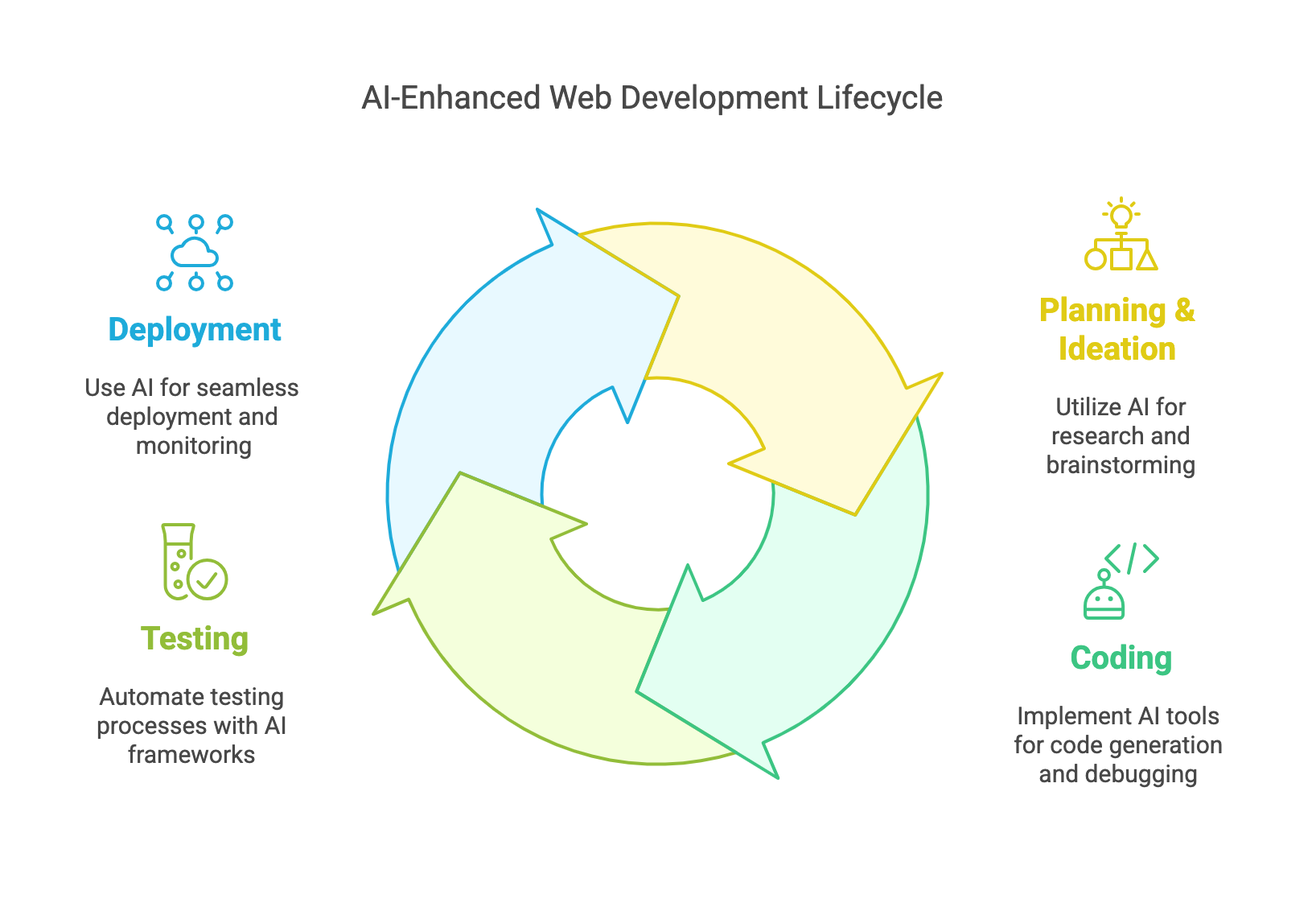
Here’s how you can effectively incorporate AI into your web development lifecycle to cultivate vibe coding:
- Vibe-Boosting in the Planning & Ideation Phase:
- AI-Powered Research & Brainstorming: Use cutting-edge AI tools to quickly gather information, explore hyper-realistic 3D design trends, analyze competitor websites with sentiment analysis capabilities, and even brainstorm nuanced project architectures that incorporate emerging quantum computing principles. This reduces the initial friction of starting from a blank slate and gets your creative juices flowing faster.
- Example: Use AI chatbots with advanced semantic understanding to ask questions like “What are the latest trends in immersive e-commerce website design for Gen Alpha, incorporating WebXR and haptic feedback?” or “Suggest highly scalable and fault-tolerant project architectures for a decentralized blog platform using serverless functions, blockchain-integrated user authentication, and AI-driven content moderation.”
- AI for Hyper-Contextual Requirements Analysis: Employ AI that goes beyond simple NLP to deeply understand the intent behind user stories, predict latent needs, identify complex edge cases with scenario simulations, and generate interactive, dynamic requirement specifications. Clear, living requirements upfront minimize confusion and roadblocks later, preserving your vibe.
- Example: Feed user stories into an AI tool – like “Project Clarity AI“ – that not only identifies ambiguities and suggests acceptance criteria but also generates interactive prototypes based on the user stories, allowing for early user testing and validation directly from the planning phase.
- Unlocking Flow State in the Coding Phase:
- Next-Gen AI Code Generation & Completion: Tools like “CodeFlow AI“ are now standard. These aren’t just about snippets; they intelligently generate entire modules, understand project-level architecture, and can even adapt to your personal coding style over time. They proactively suggest optimized algorithms and data structures based on the context of your code. This drastically reduces tedious typing, syntax errors, and boilerplate code, allowing you to stay in the flow of logic and creativity.
- Vibe Benefit: Imagine describing a complex function in natural language and having CodeFlow AI generate a highly optimized, well-documented implementation almost instantly. It’s like having a super-charged pair programmer that anticipates your every coding need.
- Predictive Error Detection & Intelligent Debugging with AI: AI-powered tools like “BugSlayer AI Suite“have evolved far beyond basic linting. They now use predictive analytics to anticipate potential runtime errors, analyze code execution paths in real-time, and even suggest intelligent fixes that take into account the broader project context.
- Vibe Benefit: BugSlayer doesn’t just flag errors; it explains the root cause in clear terms and offers multiple solution pathways, letting you resolve issues quickly and get back to the flow without frustrating dead ends.
- AI-Driven Proactive Code Refactoring & Optimization: AI can now analyze your codebase holistically, identifying areas for performance bottlenecks, security vulnerabilities, and maintainability issues. Tools like “CodeMaestro AI“ proactively suggest refactoring strategies and even automate complex refactoring tasks, ensuring your code remains clean, efficient, and vibe-worthy without interrupting your flow.
- Vibe Benefit: CodeMaestro works in the background, constantly refining your codebase like a silent guardian of quality, allowing you to focus on building features and creating value, confident that the underlying code is being continuously optimized.
- Maintaining Vibe Through Testing & Deployment:
- Autonomous AI-Driven Testing Frameworks: Testing is no longer a separate phase. AI-powered frameworks like “TestPilot AI” now autonomously generate comprehensive test suites (unit, integration, UI, even performance and security tests) based on code changes, user stories, and AI-driven vulnerability analysis. These tests run continuously in the background, providing instant feedback without requiring manual intervention.
- Vibe Benefit: TestPilot removes the drudgery of test writing and execution, giving you continuous assurance of code quality and allowing you to deploy with confidence, knowing your code is robust and reliable, thus maintaining a positive vibe throughout the development lifecycle.
- Hyper-Automated AI-Powered Deployment & Monitoring: Deployment is now seamless and virtually invisible. AI-driven platforms like “DeployZen AI“ automate every step of the deployment pipeline, from environment provisioning and configuration to canary deployments and rollback strategies. Furthermore, DeployZen continuously monitors application performance, proactively identifying and resolving issues before they impact users, using predictive analytics to prevent potential outages.
- Vibe Benefit: DeployZen eliminates the stress and potential disruptions associated with manual deployment and reactive monitoring. It ensures smooth, reliable deployments and proactive issue resolution, allowing you to maintain a positive development vibe even after code is shipped and in production.
Potential Downsides and Challenges of AI Integration
While AI offers tremendous potential to enhance vibe coding, it’s important to acknowledge potential downsides and challenges to ensure responsible and effective integration:
- Over-Reliance and Skill Erosion: Becoming overly dependent on AI tools can lead to a decline in fundamental coding skills over time. If developers rely too heavily on AI code generation without understanding the underlying principles, their ability to solve complex problems independently might weaken. It’s crucial to use AI as an augment to, not a replacement for, core coding skills.
- The “Black Box” Problem and Reduced Understanding: Some advanced AI tools operate as “black boxes,” making it difficult to understand why they suggest certain solutions. Accepting AI suggestions without critical evaluation can lead to a superficial understanding of code and potential difficulties in debugging or adapting AI-generated code in novel situations. Developers must maintain a critical and inquisitive approach, always striving to understand the “why” behind AI outputs.
- Initial Learning Curve and Tool Fatigue: Adopting new AI tools, while beneficial in the long run, often requires an initial investment of time and effort to learn their functionalities and integrate them smoothly into existing workflows. Furthermore, over-enthusiastic adoption of too many AI tools can lead to tool fatigue and context switching overload, paradoxically disrupting the flow state we aim to achieve. Strategic and selective tool adoption is key.
- Ethical Considerations and Bias: AI models are trained on vast datasets, which may inadvertently contain biases. If not carefully addressed, these biases can be reflected in AI tool suggestions, potentially perpetuating unfair or discriminatory outcomes in applications. Developers need to be mindful of ethical implications and critically evaluate AI outputs, especially in areas affecting user experience and data handling.
Addressing these challenges requires a balanced approach: using AI strategically to amplify our abilities while consciously maintaining core skills, critical thinking, and ethical awareness.
Incorporating Vibe Coding into Your Workflow: Practical Steps
- Strategically Integrate AI Tools: Explore the AI-powered development tools mentioned (Project Clarity AI, CodeFlow AI, BugSlayer AI Suite, CodeMaestro AI, TestPilot AI, DeployZen AI) and identify the ones that best address your specific workflow bottlenecks and align with your coding style. Start incrementally and expand as you become comfortable.
- Cultivate a Vibe-Conducive Workspace: Optimize both your physical and digital workspace to minimize distractions and promote focus. Invest in ergonomic setups, noise-canceling tools, and customize your development environment to feel personally inspiring and conducive to flow.
- Practice Mindful Coding & Flow Awareness: Be intentional about entering flow state. Experiment with mindfulness techniques, utilize focus timers (like Pomodoro), and take short, deliberate breaks to maintain mental freshness. Become aware of the conditions that help you enter the zone and consciously recreate them.
- Embrace Continuous, AI-Augmented Learning: Leverage AI-powered learning platforms to stay updated with the latest technologies and refine your skills efficiently. AI can personalize learning paths and surface relevant information precisely when you need it, making continuous learning a seamless and vibe-enhancing part of your workflow.
- Celebrate Milestones and Recognize Flow Moments: Acknowledge and celebrate your progress, no matter how small. Recognize and appreciate those moments when you achieve flow state. Positive reinforcement fuels intrinsic motivation and strengthens your coding vibe over time.
The Future is Vibe-Forward
The future of web development isn’t just about writing code; it’s about creating exceptional digital experiences with passion, creativity, and efficiency. By embracing vibe coding and strategically leveraging the power of AI, web developers can unlock a new level of productivity, enjoyment, and innovation in their work. So, dive in, experiment with these next-gen AI tools, and discover how they can help you amplify your coding vibe and transform your development lifecycle. Get ready to code in the zone, more often than ever before!
Related Posts
-
 August 5, 2023
The state of WordPress development in 2023: Why it is still the Ultimate CMS Powerhouse?
In 2023, WordPress remains one of the most popular content management systems (CMS) for building websites. WordPress has become 20 years old this May 27th. Here is our dedicated post on its Birthday. With over 40% of all websites built on the platform, WordPress has come a long way since
WordPress, CMS, Content Management Systems, Web Development, Web Development, wordpress0 comments -
 January 29, 2024
Is SEO Headed for Extinction, in 2024? Debunking the Misleading Headlines.
Do you remember that scene from Terminator 2 where Sarah Connor destroys a TV displaying Skynets domination? Well, that's how I felt when I came across headlines proclaiming the death of SEO in 2024. Fear not, my digital enthusiasts! The truth is far from gloomy. SEO is much alive and
