
Monolith to Microservices development in PHP – An Illustrated Guide to transform
February 11, 2025 0 comments
Ever wish your PHP application was more adaptable, easier to scale, and quicker to update? Then you’re ready to explore moving Monolith to Microservices development in PHP! In this post, we’ll leave behind the jargon and use a simple analogy to understand this powerful architectural style. Imagine your current PHP application as a massive, all-you-can-eat buffet, and microservices as a dynamic collection of specialized food trucks. We’ll break down the pros and cons of each approach, showing you how embracing the “food truck” model – microservices – can revolutionize your development workflow and lead to a more robust, future-proof application.
Okay, let’s talk about Monoliths and Microservices in a way that even the most seasoned PHP veteran can appreciate. Let’s imagine you’re a chef, since everyone understands food!
1.The “Old School” Way: The Monolith (Think a Giant All-You-Can-Eat Buffet)
Imagine you’re running a HUGE buffet restaurant. Everything happens in this one giant kitchen:
- The kitchen: This is your PHP codebase (maybe with a bit of Laravel spicing).
- All the dishes: Appetizers, salads, main courses, desserts – these represent all the different parts of your application (user login, product catalog, shopping cart, payment processing, etc.).
- The chefs: These are your functions and classes, all working together in one big space.
How it works:
- You prepare everything in this one massive kitchen. A single chef (function) might be responsible for chopping vegetables for the salad, then rushing over to stir the soup, then plating the main course. It’s all interconnected.
- If you want to change the salad dressing, you have to be careful not to spill it on the soup, since everything is so close together. In coding terms, a small change in one part of your application could accidentally break another part.
- When the dinner rush hits, the entire kitchen gets overwhelmed. It’s hard to scale just one part (like adding more dessert chefs) without affecting the whole operation. In your application, if your user login suddenly gets a lot of traffic, it might slow down the entire website.
This is your Monolith: one big, interconnected application. It’s like that old-school, procedural PHP code, maybe with a dash of a framework, where everything is tightly coupled.
| Pros (For the Chef & Developer) | Cons (For the Chef & Developer) |
|---|---|
Simple to Start:
Everything is in One Place:
One Deployment:
|
Hard to Change:
Difficult to Scale:
Technology Lock-in:
|
2.The “New School” Way: Microservices (Think a Food Truck Park)
Now, imagine a food truck park instead of a single buffet.
- Food trucks: Each truck specializes in one thing – tacos, burgers, ice cream, etc. These are your microservices.
- Each truck’s kitchen: This is a separate, independent codebase for each service, potentially using the best technology for that task (maybe PHP for one, Node.js for another, Python for another).
- Truck owners: The teams responsible for each service.
How it works:
- Each truck operates independently. The taco truck doesn’t care how the burger truck makes its patties. Each service is self-contained.
- If you want to update the taco recipe, you only change the taco truck’s kitchen. It won’t affect the other trucks. Small, independent changes are easy.
- If the taco truck gets super popular, you can just add another taco truck! You can scale each service independently based on its needs.
- Each truck can use the best tools for the job. Maybe the ice cream truck uses a fancy new freezer that the others don’t need. Each service can adopt new technologies without affecting the others.
This is your Microservices architecture: small, independent services that work together.
| Pros (For the Food Truck Park & Developer) | Cons (For the Food Truck Park & Developer) |
|---|---|
Easier to Change:
Better Scalability:
Technology Flexibility:
Resilience:
Team Autonomy:
|
More Complex to Set Up:
Communication Overhead:
Debugging Can Be Harder:
|
Why Should Old-School PHP Developers Care?
You might be thinking, “My buffet is doing just fine!” And that might be true for now. But here’s why microservices are worth considering:
- Future-proofing: The web is constantly evolving. Microservices make it easier to adapt to new technologies and user demands. You can replace a single “truck” with a new tech without changing the entire system.
- Faster development cycles: Smaller, independent services are easier to build, test, and deploy. This means you can get new features to your users faster. It is like updating the menu of each truck instead of updating the entire buffet every time.
- Improved performance and reliability: Scaling individual services and isolating failures makes your application more robust and performant, especially under heavy load.
- Easier team collaboration: Smaller codebases and independent teams lead to better organization and collaboration.
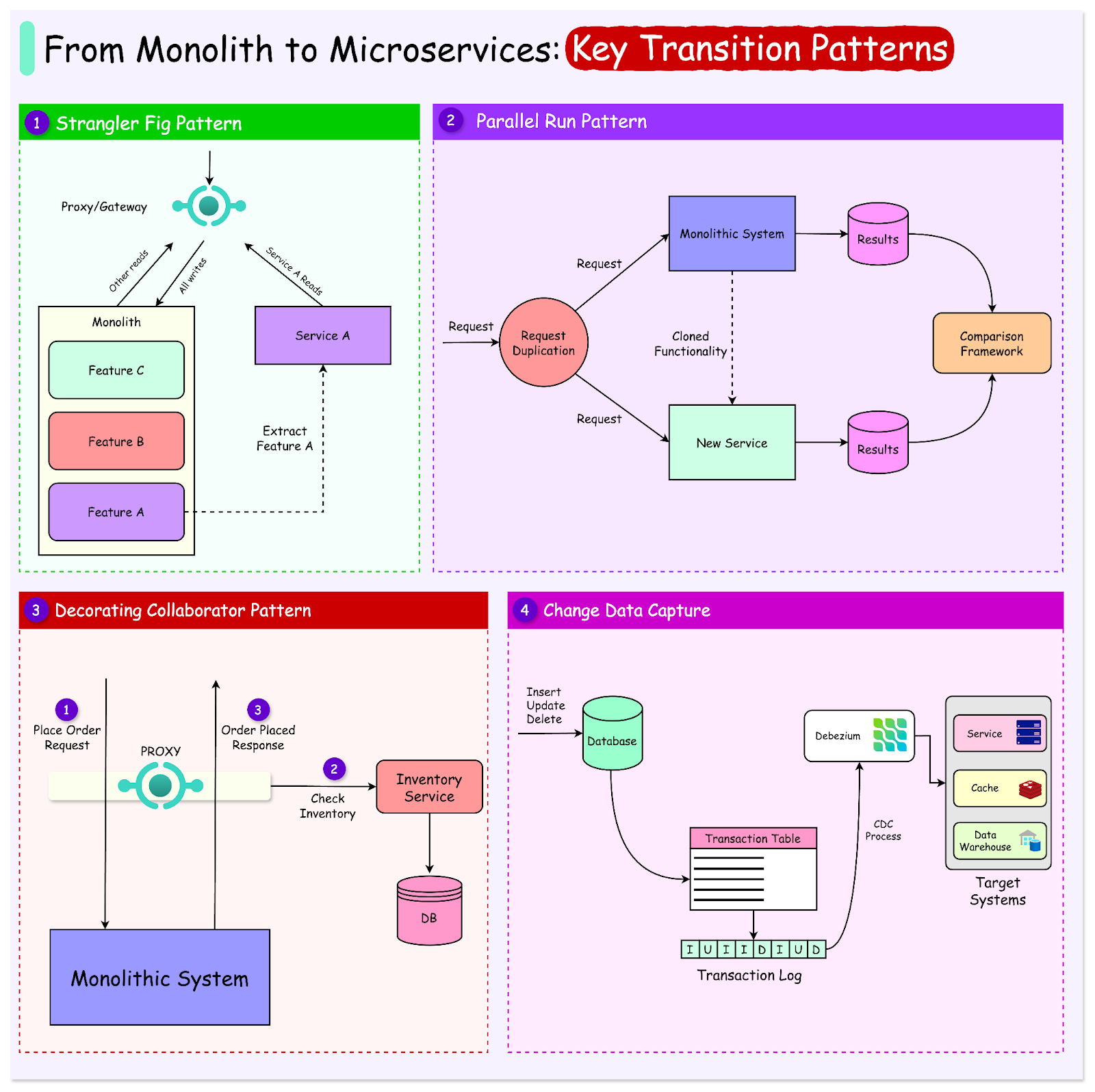
Here is the Key Transition patterns from Alex Xu of ByteByteGo.
 Making the Transition (Baby Steps)
You don’t have to tear down your entire buffet and build a food truck park overnight. You can start small:
- Identify a good candidate: Pick a part of your application that’s relatively independent and could benefit from being a separate service (e.g., a new feature, a part that needs to be scaled, or a part that’s causing a lot of problems).
- Build a new “food truck”: Create a new, separate codebase for this service, potentially using a different technology if it makes sense.
- Connect it to your buffet: Figure out how this new service will communicate with your existing application.
- Repeat: Gradually break down other parts of your application into microservices over time.
Microservices aren’t a magic bullet, but they offer a powerful way to build modern, scalable, and resilient applications. Think of it as evolving from a single, giant buffet to a more flexible and adaptable food truck park. It might seem daunting at first, but by taking small steps and understanding the benefits, even the most experienced PHP developers can embrace this new approach and reap the rewards.
Related Posts
-
 November 27, 2018
Gutenberg editor – 4 things to expect in WordPress 5.0 for website owners
The one BIG thing about WordPress 5.0 is the new Gutenberg Editor. It has been hyped a lot and maybe for a year? Well, the news is its release has been further delayed. In the meantime let’s see what Gutenberg in WordPress 5.0 holds for the user. The first
CMS, Content Management Systems, Web Development, web programming, Welcome, wordpress, WordPress0 comments -
 October 28, 2009
Four Frameworks to perform unit testing in PHP
Doing Unit testing is helps a team to produce quality application within time by allowing the developer to test the code as soon as they write it. By developing a test document, developers are forced to do rigorous testing before it reaches to QA team. This way the span of
