
Headless Magento GraphQL Performance Optimization
March 5, 2026 0 comments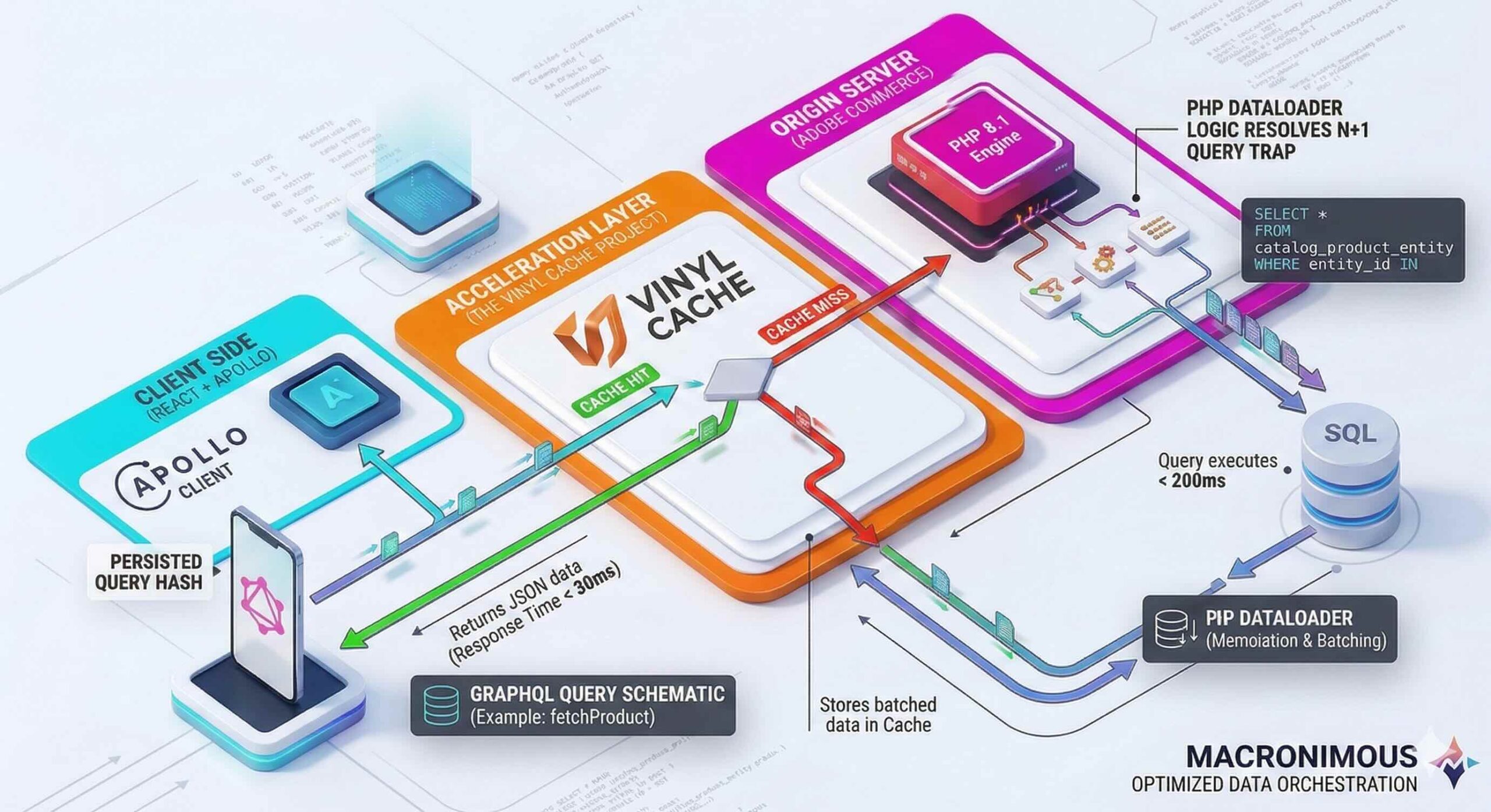
The primary bottleneck in modern Magento headless builds isn’t the React frontend; it is GraphQL query latency. While Magento’s schema offers immense flexibility, the default implementation often triggers a cascade of database requests that kill mobile performance. To achieve the sub-second interactions expected by US and UK shoppers, we must move beyond the “out-of-the-box” setup and re-engineer the data orchestration layer.
The N+1 Problem: Why Your Mobile Storefront Feels Laggy
If your product listing pages (PLPs) take more than 500ms to respond, you are likely hitting the N+1 query trap. In a standard Magento resolver, fetching a list of 20 products can trigger 21 separate database queries—one for the collection and twenty for individual attributes like “special_price” or “stock_status.”
At Macronimous, we solve this by implementing PHP DataLoaders. By batching these requests, we ensure the backend executes a single, optimized SELECT statement with an IN clause, reducing SQL execution time by up to 70%.
Infrastructure Acceleration with the Vinyl Cache Project
Traditional GraphQL requests are sent via POST, making them invisible to standard edge caches. To solve this, we leverage The Vinyl Cache Project (formerly Varnish Cache) alongside GraphQL Persisted Queries.
- Query Hashing: We map complex GraphQL strings to short, unique hashes.
- GET-based Fetching: By sending these hashes via
GET, we make the responses cacheable at the edge. - Vinyl Cache 8.0+ Integration: We utilize Vinyl’s high-speed memory storage to serve JSON payloads in under 30ms, effectively offloading 90% of the traffic from your Adobe Commerce origin server.
Optimizing the Apollo Client for High-Latency Networks
Mobile-first commerce requires resilience. We don’t just optimize the server; we tune the Apollo Client in the React frontend to handle “jittery” 4G/5G connections:
- Field-Level Fragments: We use colocation to ensure the client only requests the exact data points needed for the immediate viewport.
- Bypassing Hydration Bottlenecks: We utilize
useSuspenseQueryto ensure the UI remains interactive while data streams in, preventing the “blank screen” effect during peak traffic.
Technical FAQ: Headless Magento Engineering
How do you handle JWT Authentication between React and Magento?
In a decoupled environment, we move away from cookie-based sessions. We implement a secure JSON Web Token (JWT) flow. When a user logs in via the React frontend, the Magento backend issues a token. We store this token securely (using HttpOnly cookies to prevent XSS) and pass it in the Authorization header of subsequent GraphQL mutations, ensuring stateless and scalable session management.
What is the best way to handle Image Optimization in a Next.js/Magento setup?
Native Magento image resizing can be slow and resource-heavy. We recommend utilizing the Next.js Image Component (next/image) alongside a CDN. By pointing the loader to your Magento media folder, Next.js automatically handles WebP conversion, lazy loading, and serving correctly-sized assets based on the user’s device, significantly improving your Largest Contentful Paint (LCP) score.
Does the Vinyl Cache Project support GraphQL mutations?
No. By design, The Vinyl Cache Project (and its predecessor Varnish) should only cache GET requests (queries). Mutations (POST requests that change data, like adding to cart) must always bypass the cache to ensure data integrity. We use “Cache Tags” to invalidate specific query results in Vinyl whenever a mutation changes the underlying product or inventory data.
Is your headless infrastructure scaling with your traffic? At Macronimous, we specialize in React Magento integration and high-concurrency API tuning. Consult with our senior architects to audit your GraphQL performance.
Related Posts
-
 April 24, 2023
Best practices for React documentation for web developers in 2023
If you're new to React or looking to improve your React documentation, you've come to the right place. In this blog, we'll go over some best practices for documenting React components and features that will help make your documentation clear, concise, and easy to understand. We'll cover tips like using
JavaScript, Best Practices, Web Development, Web Development, web programming0 comments -
 November 5, 2024
Platform Engineering for Web Developers – An Introduction
Remember the good old days of web development? Back when we at Macronimous started in the late 90s and early 2000s, things were simpler. A straightforward three-tier architecture was all you needed to serve content to browsers with limited capabilities. But those days are long gone. We will be discussing
