
Future of Software Development: From Fast Builders to Master Verifiers
December 30, 2025 0 comments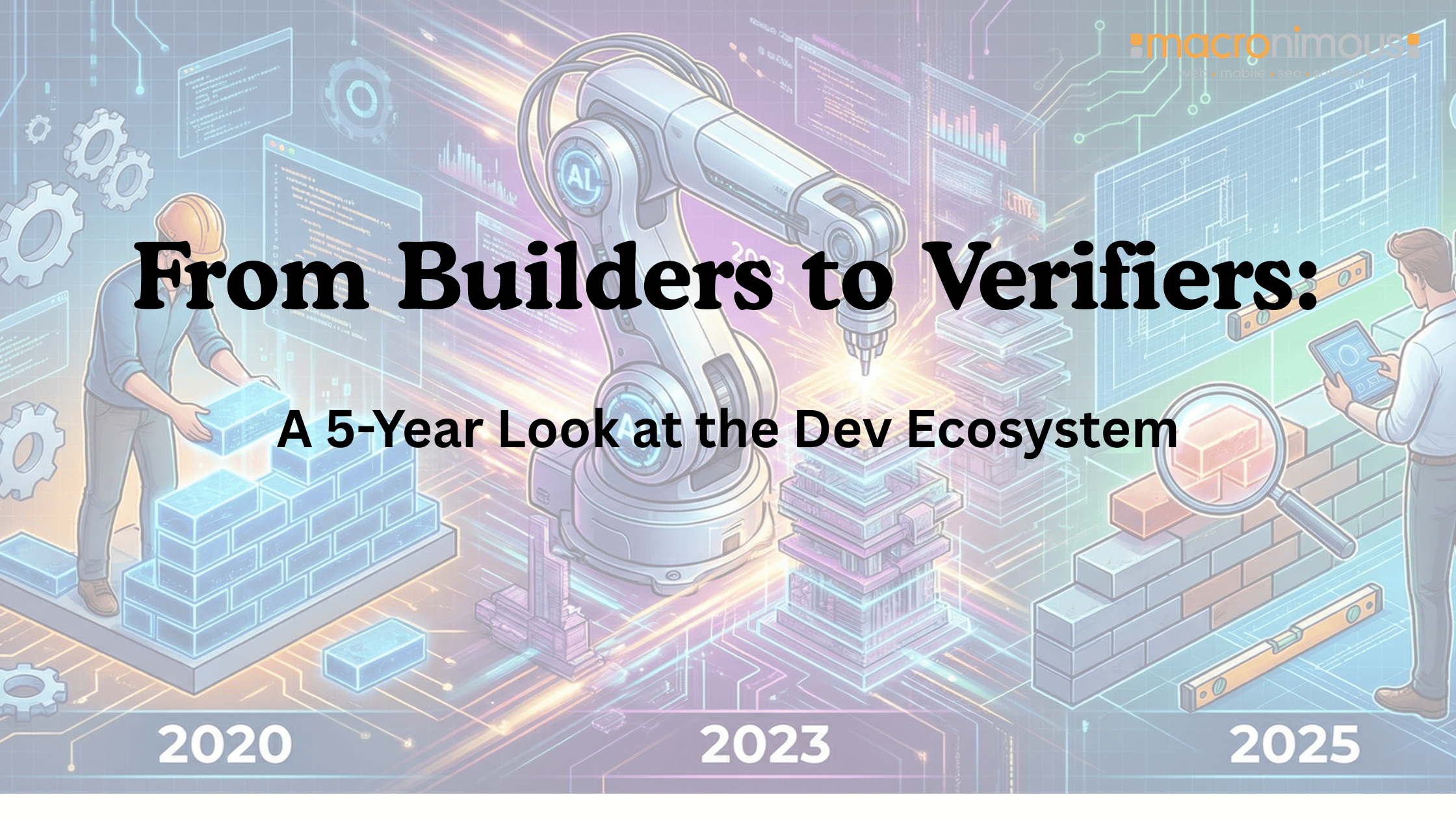
What does the future of software development in 2026 look like? Looking at the Stack Overflow survey data across 2020, 2023, and 2025, it’s clear we aren’t just seeing new tools—we are seeing a total re-calibration of how we define “productivity” and “trust.”
As a web agency owner who has navigated every tech shift since 1998, here is how I see the last five years of evolution:
2020: The “Flexible Foundation” Era
The industry was in reaction mode. Remote work shifted from a “perk” to a “mandate” (today, ~32% of devs are still fully remote). JavaScript was the undisputed king, and we were focused on building the “digital-first” world. Tools like Jira were the standard for keeping these new, distributed teams in sync. We were focused on connectivity.
2023: The “AI Honeymoon” Era
We entered the “Magic Phase.” Positive sentiment toward AI tools exceeded 70%. Developers rushed to integrate LLMs, and the focus shifted to sheer speed. Barriers to entry dropped, and we felt like we had superpowers. We were focused on acceleration.
2025: The “Cautious Transformation” Era
According to the 2025 data, the honeymoon is over. We have entered a mature, sober phase:
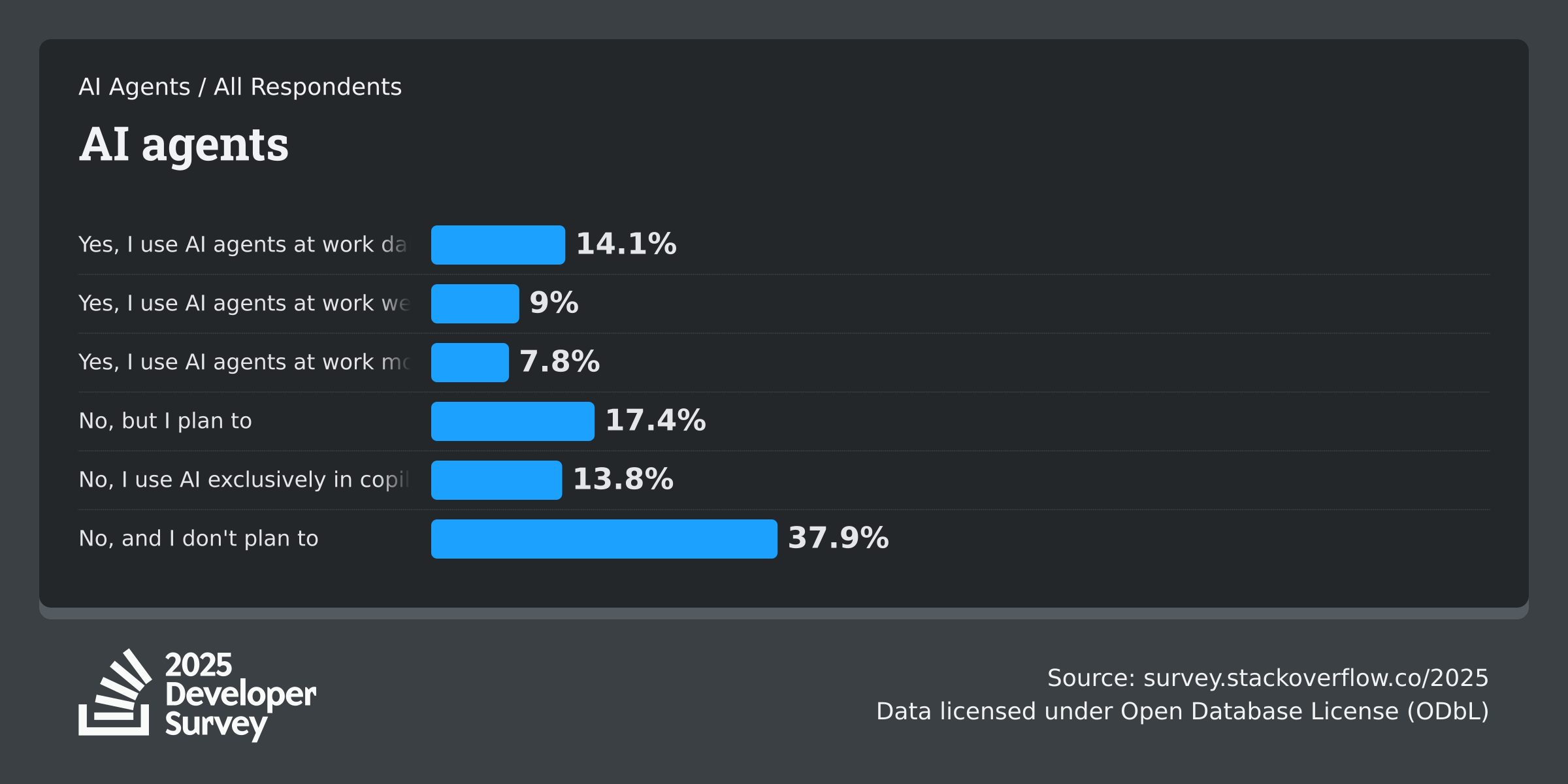
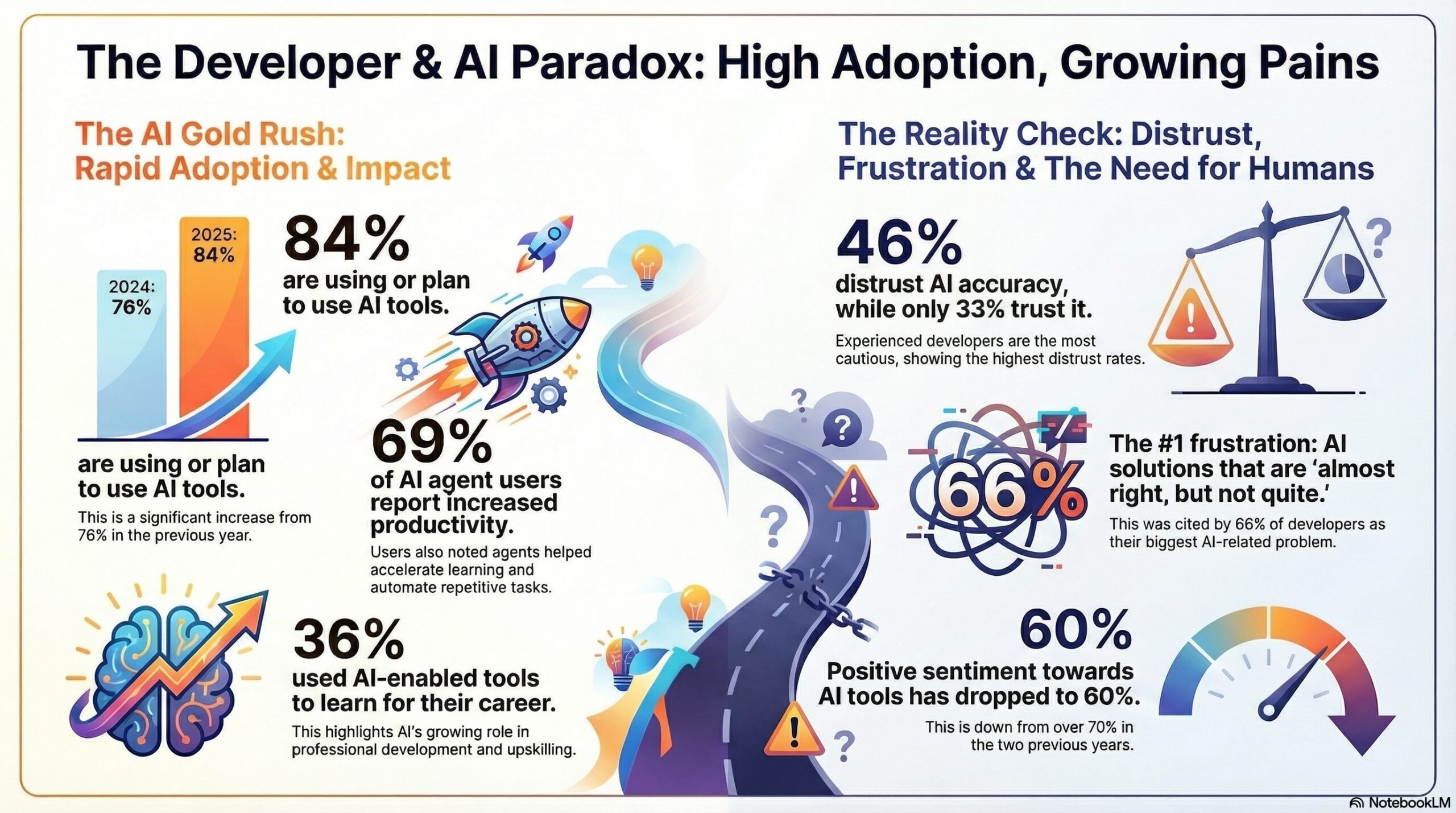
- High Usage, High Skepticism: AI usage is up to 84%, but favorable sentiment has dropped to 60%. The realization? AI is “frequently almost right,” leading to frustration for 66% of developers.
- The Python Surge: Python has jumped 7% in a single year (to 9%), officially becoming the “connective tissue” for the AI era.
- The Rise of the Architect: For the first time, “Architect” is a top-4 role. We aren’t just writing code anymore; we are designing systems that can withstand the chaos of AI agents and complex infrastructure.

My Perspective as an Agency owner:
In 2020,We hired developers who could write code fast.
In 2023, We looked for developers who used AI to write code faster.
In 2025, We are looking for “Verifiers.”
Like it or not – With 46% of developers now distrusting AI accuracy, the most valuable person in the room is no longer just the coder—it’s the one who can debug the “almost right” logic that AI produces.
The Shift in Analogy:
- 2020: We were builders carrying bricks by hand.
- 2023: We got heavy machinery (AI) and moved at record speeds.
- 2025: We realized the machine sometimes places the bricks slightly crooked. Now, the most important person on the site isn’t the driver—it’s the inspector with the level and the blueprint.
Looking Ahead: 2026 and the “Orchestration Era”
As we look toward 2026 and beyond, my prediction is that the current friction of manual verification will become unsustainable. The industry will respond with a new wave of tooling focused not on generation, but on autonomous validation—think AI agents dedicated solely to security auditing, or automated testing suites designed specifically to catch “LLM hallucinations.” We will move rapidly from the current “Verification Era” into the “Orchestration Era.” In this new reality, the most valuable developers won’t just be checking the AI’s work; they will be defining the high-level business logic and managing the interplay between multiple specialized AI agents, finally elevating the human role from site inspector to master planner.
Related Posts
-
 March 31, 2010
Frameworks we like: 4. Codeigniter, and Why?
Codeigniter is an opensource web application framework for building dynamic websites with programming language PHP. Its main aim is to facilitate the developers to develop projects much faster than writing code from scratch. If you are a developer who wants to meet the clients’ deadline and tired of tediously large
Frameworks, General, Opensource, PHP Programming, web programming, Web standards, Web tools2 comments -
 July 15, 2023
Is Magento Still a Viable Ecommerce Platform in 2023? A Look at Adobe’s Ownership and the Pros and Cons of Using Magento
Magento is a popular e-commerce platform used by businesses of all sizes around the world. Magento is now renamed by Adobe as Adobe commerce, But still the name Magento is widely in use due to its popularity. Magento is still available as Open source, which was Originally released as an
