
Preparing for Agentic Commerce Implementation: A Technical Guide to UCP for Developers
January 16, 2026 0 comments
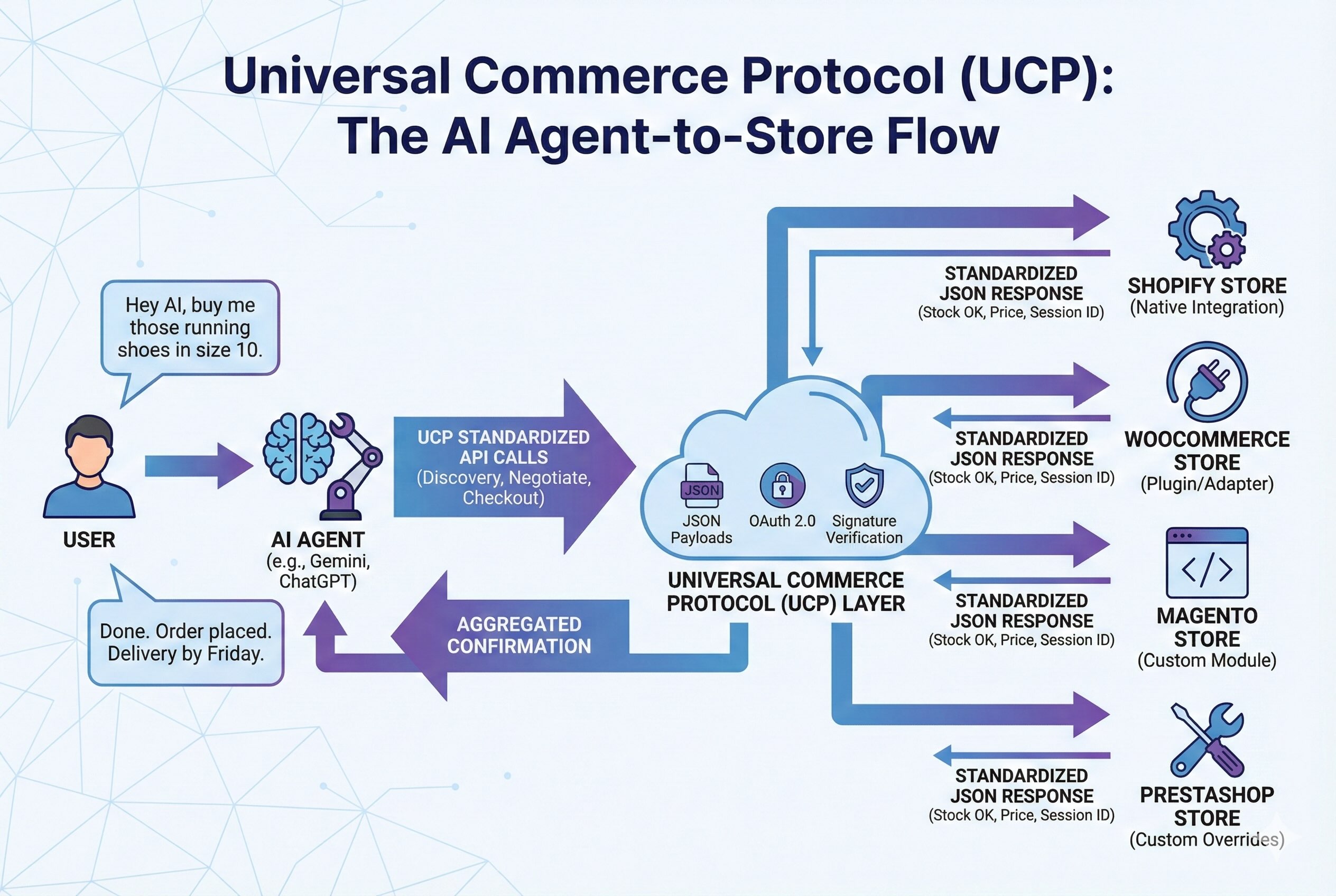
January 2026 marks a pivotal shift in the digital commerce landscape with Google’s launch of the Universal Commerce Protocol (UCP). We are moving from an era where humans browse websites to an era of “Agentic Commerce,” where AI agents (like Gemini, ChatGPT, or specialized bots) discover, negotiate, and purchase products on a user’s behalf. For development teams at Macronimous and our clients, this means the immediate challenge is mastering Universal Commerce Protocol implementation.
If you are a developer I recommend you to give a quick visit to the developers guidelines here.
Instead of building a visual frontend for human eyes, UCP requires us to build standardized API endpoints for AI interpretation. This blog breaks down what UCP is technically, how it impacts the major platforms we support, and the immediate action steps developers need to take.
The Problem UCP Solves: The “N x N” Complexity
Until now, if an AI assistant wanted to purchase a product from 10,000 different online stores, it would technically require 10,000 custom integrations to understand how each store’s cart, checkout, and inventory systems work. This is unscalable.
UCP acts as a standardized lingua franca. It is an open, RESTful API standard using JSON payloads that allows any e-commerce store to “speak” directly to any certified AI agent. It standardizes three core pillars of commerce:
- Discovery: How an agent learns what a store sells and what UCP features it supports.
- Capabilities Negotiation: How the agent asks real-time questions like, “Is SKU-123 in stock?” or “Can this be shipped to zip code 90210?”
- Checkout Execution: A standardized session for securely completing the transaction without the user ever visiting the store’s domain.
The Developer Paradigm Shift
For developers used to building traditional Magento or WooCommerce sites, UCP requires a shift in mindset toward “Headless” and API-first architectures.
Key Technical Requirements:
- The Discovery Endpoint: You must implement a .well-known style endpoint. This is where your store declares its supported UCP capabilities (e.g., dev.ucp.shopping.checkout, dev.ucp.shopping.discount).
- State Management (The “Checkout Session”): The traditional “Cart” object, often tied to a user’s browser cookie, is replaced by a server-side “Checkout Session.” Your backend must be able to create, update, and finalize this session state via API calls from the AI agent.
- Security is Paramount:
- Request Signing: Requests coming from agents (like Google) will be cryptographically signed. Your endpoints must verify these signatures to prevent spoofing.
- OAuth 2.0: This is required for “Account Linking.” If a user wants the AI agent to use their existing store account and saved addresses, you must implement an OAuth flow to grant the agent permission.
Platform-Specific Impact Matrix
The effort required for Universal Commerce Protocol implementation varies significantly depending on the underlying architecture of the e-commerce platform. Below is a breakdown of how UCP affects the major platforms we support at Macronimous.
| Platform | Integration Strategy & Effort Level | Technical Considerations for Developers |
| Shopify | Low Effort (Native/Configuration). As a launch partner, Shopify’s integration is largely native. It is activated via the Google & YouTube Sales Channel settings as “Agentic Checkout.” | Focus on ensuring product data feeds utilize new native_commerce attributes. Minimal coding required; primarily configuration and data hygiene. |
| WooCommerce | Medium Effort (Plugin/Adapter). Expect official plugins or adapters utilizing the Model Context Protocol (MCP) to act as the bridge between UCP and Woo Core. | Developers will need to install, configure, and test these adapters. Key work involves mapping UCP standardized fields (Line Items, Shipping Rates) to WooCommerce internal objects. |
| Magento (Adobe Commerce) | High Effort (Custom Module). Currently, requires building custom modules to expose UCP-compliant REST endpoints. | You must map the UCP Checkout Session to Magento Quote objects. Crucially, implement aggressive caching strategies for inventory/price checks, as AI agents may poll frequently. |
| PrestaShop | High Effort (Custom Overrides). Similar to Magento, this requires significant custom development to create the necessary API layer. | Developers will need to override standard controllers to accept and process UCP JSON payloads. Ensure Google Merchant Center feeds are updated to signal UCP eligibility. |
Action Plan for Developers and Technical Leads
First, you may have to explain this to your clients; while some forward-thinking merchants might already be aware of Agentic Commerce, others will need guidance on why this shift matters. To prepare both your clients and your internal teams for this shift, you need to execute a clear plan, but it is vital to communicate that this is a new integration layer, which implies there is a budget for this additional work. Depending on the platform and specific requirements, you can achieve this implementation either through custom code for bespoke architectures or by leveraging commercial and open-source plugins or extensions for a more streamlined, cost-effective rollout.
Phase 1: Immediate Prerequisites (Weeks 1-4)
- Master the Spec: Lead developers must review the official UCP specification documentation (available at ucp.devor associated GitHub repos) to understand the required JSON structures.
- Data Hygiene is Critical: UCP relies heavily on data feeds (like Google Merchant Center) to “match” user intent to products. Before writing code, ensure client product data is pristine. Missing GTINs, incorrect stock status, or vague descriptions will break the AI discovery process.
- Security Infrastructure: Begin reviewing existing OAuth 2.0 implementations on custom platforms. A successful Universal Commerce Protocol implementation hinges on secure request signature verification, so plan the necessary middleware for Magento/PrestaShop now.
Phase 2: Pilot Implementation (Months 2-3)
- The “Hello World” of UCP: On a staging environment for a flexible platform (ideally WooCommerce), attempt to implement just the Discovery Endpoint. Verify that an external tool can read your store’s capabilities.
- Rethink the Cart: Start architecting how your chosen platform handles server-side cart sessions decoupled from browser cookies. This is often the hardest part of headless implementations.
Conclusion
UCP is not just another sales channel; it is the infrastructure for the next decade of commerce. By understanding the technical requirements now, Macronimous can help our clients transition from merely having a website to being fully accessible to the emerging economy of AI agents. The time to start preparing your architecture is today.
Related Posts
-
 January 24, 2024
Why You Should Use ChatGPT Rather Than Google Search – ChatGPT vs Google Search
ChatGPT vs Google Search? Comparing ChatGPT with Google Search might initially seem unusual, but this comprehensive guide will illuminate why and when switching to ChatGPT can be more advantageous than relying solely on Google Search. In today's era, Google has long been the go-to platform, for accessing information. However, with
ChatGPT, Google SEO, Search Engine Optimization, SEO, Welcome0 comments -
 January 5, 2026
Beyond the Algorithm: Crafting Your SEO Strategy 2026 After a Year of Disruption
The New Normal If 2024 was the year AI arrived, 2025 was the year it took over. As we look back at a turbulent year for search, one thing is clear: the old playbook of "10 blue links" is disappearing. For business owners and developers, building a robust SEO Strategy 2026 is
