
Headless Magento with React – Your Magento Store is Powerful. But is it Fast Enough?
September 15, 2025 0 comments
Your Magento Store is Powerful. But is it Fast Enough?
At Macronimous, we’ve built and managed countless applications on PHP, with a special focus on Magento. We know its power. It’s a robust, scalable e-commerce engine that can handle complex catalogs and business logic like no other. But as we started our journey into modern frontend technologies like React, we realized something crucial.
The biggest hurdle for Magento stores today isn’t the backend—it’s the traditional frontend experience.
We’ve successfully guided clients in pairing a React frontend with their Magento backend. It’s a challenge, especially for large-scale stores, but the results are transformative. This post explains why this “headless” approach is the future for serious e-commerce, both for the business owner and the developer.
The “Old Way”: Why Traditional Magento Frontends Feel Clunky
Without getting too technical, a traditional Magento site operates on a simple cycle:
- A customer clicks on a product, a category, or a filter.
- Their browser sends a full request to your server.
- Magento works hard to build the entire new page from scratch—header, footer, sidebars, everything.
- It sends that complete HTML page back to the customer.
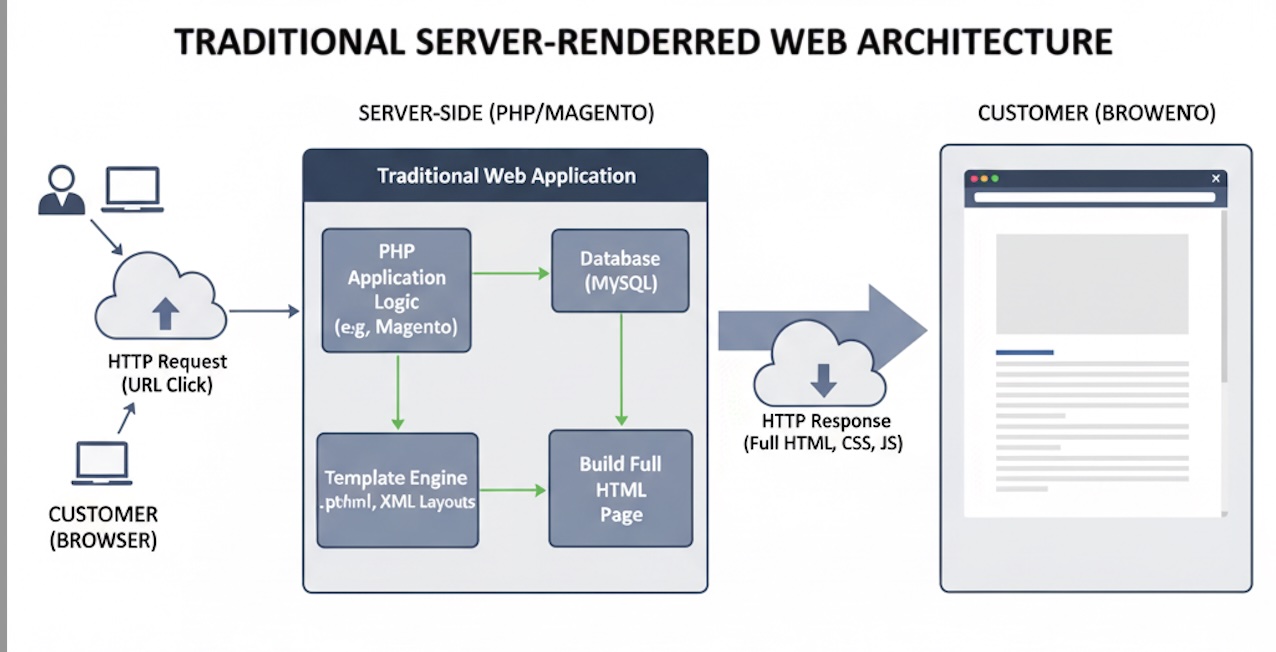
Think of it like a customer in a physical store having to ask a clerk to bring them a whole new printed catalog every time they want to look at a different item. It works, but it’s slow and interrupts the shopping flow.
This model was fine a decade ago, but today it leads to tangible business problems:
- Slow Page Loads: Every click involves a delay, causing shopper frustration.
- Poor User Experience: Applying multiple filters or navigating categories feels sluggish.
- Higher Cart Abandonment: A slow, clunky checkout process is a primary reason customers leave.
- Lower SEO Scores: Google’s Core Web Vitals penalize slow, unresponsive sites.
The “New Way”: Instant, App-Like Speed with a React Frontend
Now, imagine a different approach. Instead of a printed catalog, you hand your customer a super-fast digital tablet. The main application is loaded just once. When they want to see a new product, only that product’s information is instantly fetched and displayed on the screen. The rest of the tablet’s display (the header, the menu) remains untouched.
This is exactly how a React frontend works with Magento. This is often called “Headless Magento.”
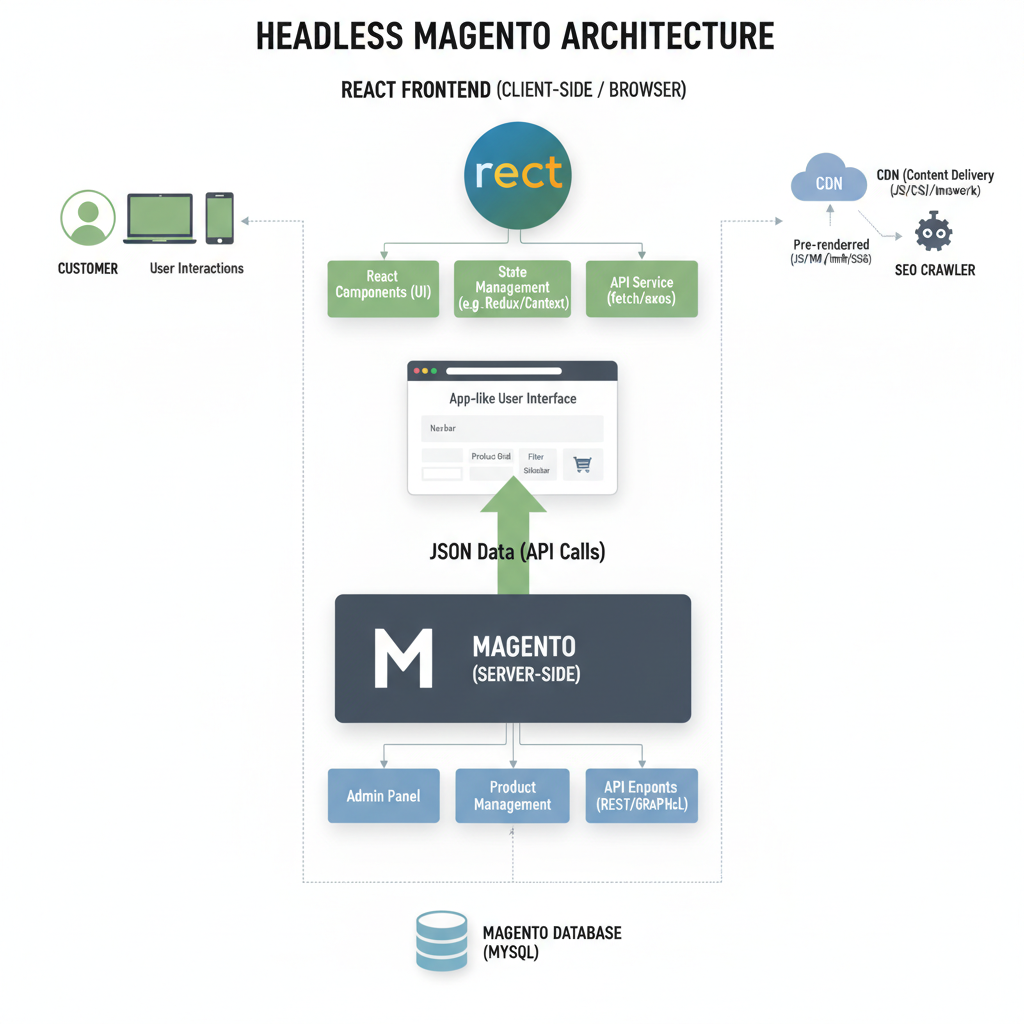
Your powerful Magento backend remains in place, managing products, orders, and customers. It just sends raw data (JSON) to the frontend. The React application, which runs in the user’s browser, handles all the visuals.
The business benefits are immediate and significant:
- Blazing-Fast Speed: Navigating between pages, filtering products, and searching becomes nearly instantaneous.
- A Modern, App-Like Feel: The store feels smooth and responsive, like a native mobile application, which dramatically improves the customer’s perception of your brand.
- Higher Conversion Rates: A faster, more enjoyable experience directly reduces friction and leads to more completed purchases.
- Better SEO Performance: The speed and improved user experience metrics are exactly what Google wants to see, leading to better rankings.
- Unmatched Design Flexibility: You are no longer constrained by Magento’s theme structure. You can build a completely unique, branded customer experience from the ground up.
For Your Developers: Making the Mental Shift
For this to work, your development team needs to think differently. If they’re used to the old Magento way, they must shift their perspective from building “pages” to building a “state-driven application.”
Here’s the core of that mental shift:
- From Server Pages to a Client-Side App: They must stop thinking about the server building HTML pages. The new world is a JavaScript application that lives in the browser and just talks to the Magento API for data.
- From Request-Response to State Management: Instead of a full page reload to show new data, they will simply update a variable in the app (the “state”), and the UI will instantly react to that change. A click on a color swatch doesn’t reload the page; it updates the
selectedColorstate, and the product image and price instantly change. - From Pages to Reusable Components: Their new job is to break the UI down into small, independent, and reusable “components”—a
<ProductCard>, a<PriceDisplay>, a<FilterSidebar>. This makes development faster and more maintainable in the long run.
To summarize this new way of thinking, here is a direct comparison:
Magento vs. React: A Shift in Thinking
| Concept | The Traditional Magento Way | The Modern React Frontend Way |
| How Pages are Built | Magento’s server builds a full HTML page for every click, combining themes, layouts, and blocks. | A single, fast JavaScript application loads once in the browser. |
| User Experience | Full page reloads when a customer filters, sorts, or clicks a category, causing a noticeable delay. | Only the specific parts of the page that need to change are updated instantly. No reloads, no waiting. |
| Architecture | A rigid structure of themes, XML layouts, and .phtml template files. |
A flexible tree of reusable components like <ProductGallery /> or <MiniCart />. |
| Data Handling | Product and customer data is loaded on the server and embedded directly into the HTML templates. | The React app fetches data from Magento’s API and manages it in the browser, updating the view as needed. |
| Overall Feel | A classic, reliable website experience that can feel slow or “heavy” to a modern user. | A lightning-fast, fluid, and “app-like” experience that boosts engagement and conversions. |
The Best of Both Worlds
Adopting a React frontend is not about replacing Magento. It’s about unleashing its power. You keep the robust, secure, and scalable e-commerce engine you trust while bolting on a world-class, lightning-fast customer interface.
It’s a significant upgrade, but one that is essential for competing in the modern digital marketplace. If you’re ready to transform your store’s performance and provide an experience your customers will love, this is the way forward.
Related Posts
-
 November 5, 2024
Platform Engineering for Web Developers – An Introduction
Remember the good old days of web development? Back when we at Macronimous started in the late 90s and early 2000s, things were simpler. A straightforward three-tier architecture was all you needed to serve content to browsers with limited capabilities. But those days are long gone. We will be discussing
ECommerce Development, PHP Programming, Web Development, web programming, Welcome0 comments -
 April 24, 2023
Secure Your PrestaShop ECommerce Website: A Comprehensive Guide for Business Owners to Protect Their Online Store and Customer Data
Secure Your PrestaShop ECommerce Website: A Comprehensive Guide for Business Owners to Protect Their Online Store and Customer Data : As an ECommerce website owner, securing your website should be a top priority. With the rise of online shopping, the threat of security breaches and cyberattacks has become more prevalent.
