
EmDash vs WordPress
April 7, 2026 0 comments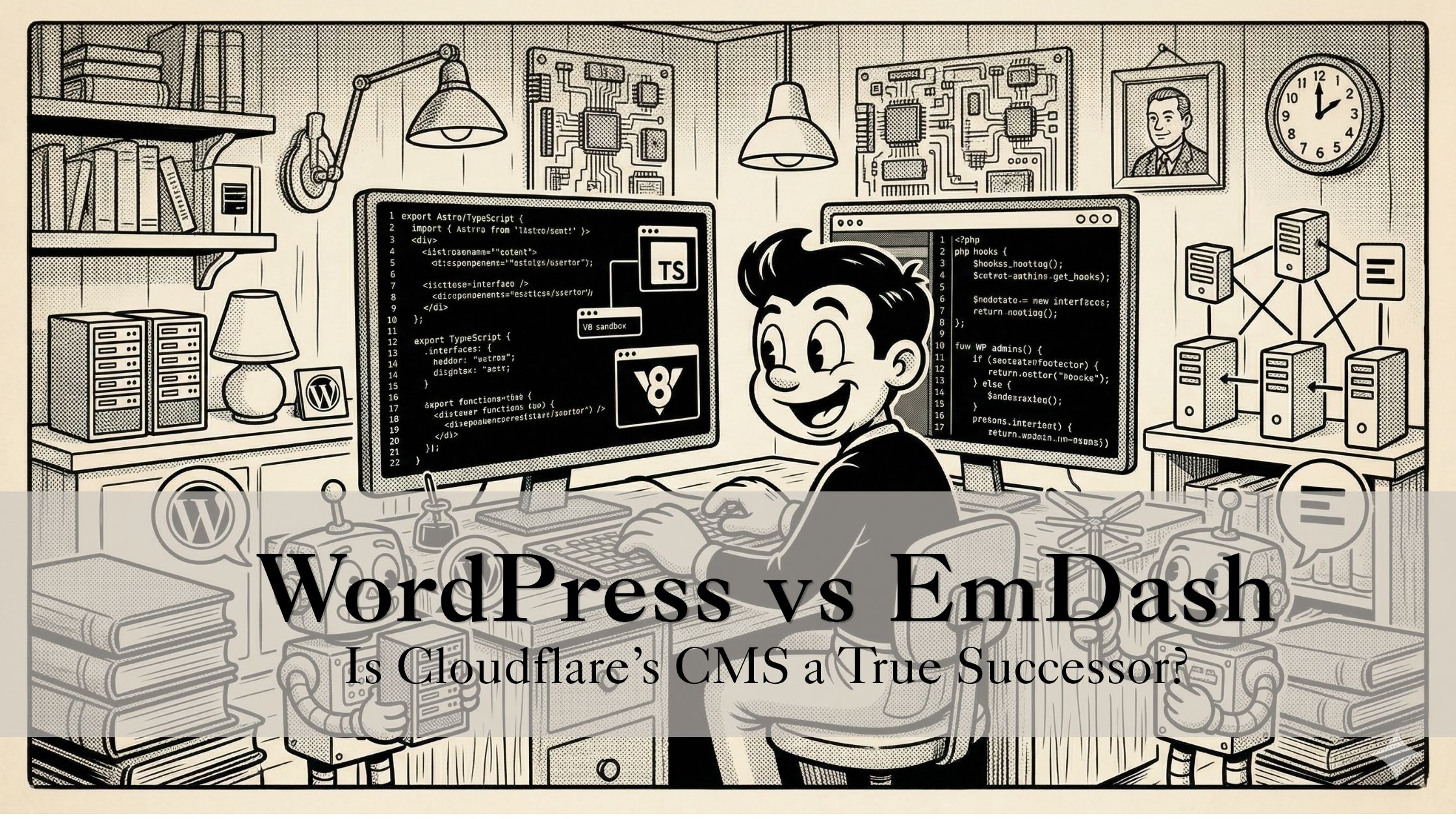
EmDash vs WordPress: Is Cloudflare’s CMS a True Successor?
A Technical and Agency Risk Assessment
Your agency just recommended a new platform. They called it modern, secure, and AI-native. They said it’s the spiritual successor to WordPress. The platform is Cloudflare’s EmDash, and this is the pitch you’ll hear at every tech conference this year.
Before you sign off, there are things worth examining.
At Macronimous, we’ve navigated every major web platform evolution since 2002. We’ve seen Joomla peak and fade, watched Wix and Squarespace mature, evaluated Webflow’s rise, and stress-tested AI site builders like Figma Sites and Lovable. The pattern is always the same: architectural change is presented as automatic progress. It isn’t.
EmDash is not a WordPress replacement. It is a pivot into a fundamentally different—and restrictive—model. It is serverless, edge-first, and tightly coupled to a single vendor’s ecosystem. For anyone responsible for a business’s long-term digital ROI, that distinction is everything.
1. The Technical Pivot: V8 Isolates vs. The Hook System
The core argument for EmDash is security. Let’s examine what that security actually costs.
- WordPress: Plugins operate with full access to the database and filesystem. This creates infinite flexibility but a massive surface area for risk.
- EmDash: Plugins run inside V8 isolates with a capability-based permission model. Nothing is accessible unless explicitly granted.
The V8 isolate model does solve the “rogue plugin” problem. But it introduces significant developer friction. In WordPress, extending behaviour is a simple add_action hook—a few lines of PHP and you’re done. In EmDash, you are designing interaction contracts. You must define permissions upfront, manage isolated execution contexts, and pass structured data across rigid boundaries. Even a simple feature—adding a custom field to a contact form, say—requires navigating this permission architecture.
The Verdict: You trade open extensibility for controlled execution. The runtime is safer, but development cycles slow down and the cognitive load increases for even the simplest customisations. For agencies billing by the hour, that friction becomes a direct cost to the client.
2. The State Problem: Edge-Native vs. ACID Compliance
EmDash runs entirely on Cloudflare Workers, eliminating the traditional origin server.
- WordPress Model: PHP + MySQL at the origin, optimised with Redis caching and CDN delivery.
- EmDash Model: Code runs at the edge; data lives in D1, Cloudflare’s SQLite-based distributed database.
For static marketing sites, this is lightning fast. Pages load from the nearest edge node with minimal latency. But for anything involving complex data relationships, the edge is a liability.
Consider a real scenario: an E-commerce site processing concurrent orders during a flash sale. Two customers attempt to purchase the last unit of a product at the same time, hitting different edge nodes. With MySQL’s ACID compliance, one transaction succeeds and the other fails cleanly. With D1’s eventual consistency model, both nodes may report the item as available. The result is an oversold product, a customer service headache, and a bug that is nearly impossible to reproduce in testing because it depends on network timing between edge nodes.
The same risk applies to multi-role dashboards, user progress tracking in EdTech platforms, and any application where two users can modify the same record.
The Verdict: You aren’t eliminating infrastructure complexity; you’re trading server complexity for data consistency risks. For static sites, the trade-off is favourable. For transactional applications, it’s dangerous.
3. The “AI-Native” Claim: Marketing Differentiator or Technical Necessity?
EmDash leans heavily on being “AI-native” via the Model Context Protocol (MCP). This deserves a more careful look than the marketing copy provides.
MCP is a genuinely interesting protocol. We use it ourselves in our internal workflows for connecting AI tools to live data sources. But the question isn’t whether MCP has value—it does—it’s whether you need to switch your entire CMS to get it.
You don’t. WordPress already provides structured data through its REST API and WP-GraphQL. Any AI tool that can consume an API can already work with a WordPress site. MCP integration can be layered on top of an existing WordPress installation without replacing the foundation. Switching your entire backend for a native AI protocol is like rebuilding your house because you want a better thermostat.
There is also what we call the AI Builder Paradox. We’ve tested this extensively with platforms like Figma Sites and Lovable. AI is excellent at generating standard layouts: hero sections, feature grids, and testimonial carousels. The output looks polished in a demo. But the moment a client requires unique business logic—a custom pricing calculator that pulls from a third-party API, a booking flow with conditional availability rules, a member portal with role-based access—the AI hits a wall. It generates the skeleton but cannot reason about the business rules.
We’ve seen AI-generated sites ship with hardcoded sample data in production, with forms that submit to nowhere, and with responsive layouts that collapse on tablet viewports. These are not edge cases; they are the norm once you move beyond template-grade output.
The Verdict: MCP is a useful protocol, not a reason to change platforms. AI-native is a marketing differentiator, not a technical necessity. The real question is whether your CMS gives AI tools clean data to work with—and WordPress already does.
4. SEO Reality: Guardrails vs. Open Air
This is where the risk becomes most tangible for business owners.
WordPress has a mature SEO ecosystem. Plugins like Yoast and RankMath handle canonical tags, XML sitemaps, Open Graph metadata, schema markup, and crawl directives automatically. Misconfigure something, and these tools flag it before it reaches production. The safety net is deep and well-tested across millions of sites.
EmDash, built on Astro, has no such safety net. SEO implementation is entirely manual and written in TypeScript.
Here’s what an invisible failure looks like in practice: a developer deploys an Astro page with server-side rendering (SSR) but introduces a hydration mismatch. The page looks fine in a browser. But Google’s crawler sees the server-rendered version, which may be missing the canonical tag, the structured data, or even the primary heading. Over the following weeks, the page silently drops in rankings. By the time it shows up in Search Console as a coverage issue, you’ve already lost weeks of organic traffic.
Or consider a simpler scenario: a missing canonical tag on a paginated archive. In WordPress with Yoast, this is handled automatically. In EmDash, it’s a line of TypeScript that someone has to remember to write, test, and maintain across every template. Forget it once, and you’ve created a duplicate content problem that dilutes your domain authority.
The Verdict: WordPress gives you guardrails. EmDash gives you open air. For an agency managing SEO across multiple client sites, the risk of invisible, silent failure is not theoretical—it’s operational.
Beyond the technical architecture, there are practical realities that affect your budget, your team, and your long-term ownership of your digital assets.
The Pioneer Tax: When an agency recommends an unproven, niche platform like EmDash, your project budget often stops funding your business goals and starts funding the agency’s Research and Development. Because EmDash lacks a mature marketplace, standard features—contact forms, SEO tools, analytics integration—must be custom-engineered from scratch. You are effectively paying for a developer’s learning curve and the creation of basic infrastructure that already exists off-the-shelf in the WordPress ecosystem.
- Predictable Rent vs. Algorithmic Billing: WordPress has a predictable total cost of ownership, often with a fixed monthly hosting fee. EmDash uses usage-based billing where you pay for “CPU time”—every request and edge computation is metered. A traffic spike that WordPress handles with a simple caching plugin becomes an unpredictable, volatile invoice on the Cloudflare stack.
- The Talent Problem: WordPress has a global developer talent pool. If your lead developer leaves, you can find a replacement. EmDash requires a niche combination of TypeScript, Astro, and Cloudflare Workers expertise. If your key developer moves on, the client isn’t just losing a team member—they are potentially stranded on a platform that very few people know how to maintain.
- The Ownership Trap: This is the most critical issue. WordPress is protected by the GPL—a license that guarantees the user’s rights to own, move, and modify their code. EmDash uses the MIT license for its source code, but the runtime is proprietary to Cloudflare. If you decide to leave Cloudflare due to pricing changes or service issues, you don’t migrate; you rewrite. Recommending this level of vendor lock-in without disclosure is a fundamental breach of trust regarding digital asset ownership.
6. The Macronimous Stance: Technical Curators, Not Just Builders
The “No-Code” and “AI-Native” era hasn’t eliminated the need for professional guidance. It has changed our job description.
We are no longer just builders. We are Technical Curators. Our role is to evaluate every new platform, protocol, and tool—and to make an honest recommendation based on what actually serves the client’s long-term interests. Not what generates the most exciting demo. Not what looks best in a pitch deck. What works, what lasts, and what you’ll actually own five years from now.
We believe in a hybrid future where AI strengthens the open web—acting as a security auditor, a content assistant, and a development accelerator within established ecosystems—rather than a corporate future where the web is locked behind a single vendor’s sandbox.
We test everything so our clients don’t have to. Right now, that means we are:
- Benchmarking D1’s consistency under write-heavy, concurrent scenarios to understand its real-world limits.
- Monitoring the EmDash community for genuine, non-corporate contributions.
- Mapping exit strategies to quantify the true cost of migrating away from the Cloudflare stack.
Until a platform demonstrates the maturity, the ecosystem depth, and the ownership guarantees that WordPress provides, our recommendation remains clear.
WordPress remains the industry’s operating system.
It balances flexibility, stability, and—most importantly—ownership. We build for the next decade. Not the next trend.
Expert Guidance for Your Next Platform Move
Are you weighing the “Pioneer Tax” of EmDash against the proven stability of WordPress? Whether you need a secure WordPress build, a specialized EmDash implementation, or a strategic migration assessment, we provide the technical vetting required for long-term ROI.
We evaluate the architecture, the consistency risks, and the exit strategies so you don’t have to.
Frequently Asked Questions
Is EmDash really more secure than my current WordPress site?
Yes, from a structural standpoint. While WordPress plugins traditionally operate with full access to the database and filesystem, creating a large surface area for risk, EmDash runs plugins inside “V8 isolates” with a capability-based permission model. This means a plugin cannot access your data unless explicitly granted permission, effectively solving the “rogue plugin” problem.
Will moving to a serverless platform like EmDash save me money on hosting?
It depends on your traffic patterns. WordPress typically runs on a predictable, fixed-cost model, often as low as five to ten dollars a month. EmDash is serverless and bills by “CPU time”—meaning every request and function execution is metered. While this sounds efficient, a sudden traffic spike or a bot attack could result in an unpredictable and volatile monthly bill compared to a stable, fixed hosting plan.
Do I need a new CMS to make my business “AI-ready”?
Not necessarily. While EmDash is marketed as “AI-native” via the Model Context Protocol (MCP), your existing WordPress site already provides structured data through its REST API and WP-GraphQL. Any AI tool that can consume an API can already work with a WordPress site. You don’t need to rebuild your entire house just because you want a better thermostat; MCP integration can often be layered onto existing foundations.
Does the “Edge-Native” architecture handle e-commerce and transactional data reliably?
This is a significant risk area. WordPress relies on MySQL’s ACID compliance to ensure data consistency during concurrent tasks, such as two people buying the last item in stock simultaneously. EmDash uses D1, which follows an “eventual consistency” model. In high-concurrency scenarios, this can lead to data errors, such as overselling products, which are nearly impossible to reproduce in standard testing due to network timing variables.
How does the development workflow compare when customizing features?
EmDash introduces considerably higher “developer friction.” In WordPress, extending behavior is often a simple few-line hook. In EmDash, you are designing “interaction contracts,” managing isolated execution contexts, and passing data across rigid boundaries. This increased cognitive load slows down development cycles for even the simplest customizations, which translates to a direct cost increase for the client.
What is the long-term risk of moving clients away from the WordPress ecosystem?
The primary risks are the “Pioneer Tax” and “Vendor Lock-in.” WordPress has a global talent pool and is protected by the GPL, allowing you to move a site to any host at any time. EmDash uses the MIT license for its code, but the runtime is proprietary to Cloudflare. If a client ever needs to leave the Cloudflare ecosystem, they cannot simply migrate; they must perform a total architectural rewrite.
Related Posts
-
 September 20, 2018
Why Should Headless CMS Be on Your Radar?
A recent Forrester research shows that almost 70% of the respondents either use or are planning to implement a content management system (CMS) in one form or the other. But unfortunately, the pace at which CMS tools are evolving is slower than the rapid strides taken by technology evolution. So it
CMS, Content Management Systems, PHP Programming, web programming, Web tools0 comments -
 October 26, 2023
Supercharge Your Site with Gatsby WordPress Integration: A Developer’s Guide
Gatsby WordPress Integration? What is that? Is that something to do with my left-hand? Or a snack? As a WordPress developer, you're already familiar with the vast ecosystem of plugins, themes, and the loop. But have you ever felt limited by PHP and traditional server-rendered pages when it comes to
